Table of Contents
- Quick answer: how much house can you afford?
- What are mortgage affordability rules of thumb?
- The 28/36 rule explained
- Example: how the 28/36 rule works
- What should count as a housing cost?
- Why lender approval is not the same as affordability
- Costs that can make a home less affordable
- How interest rates change affordability
- Do not ignore your take-home pay
- A safer way to estimate your home budget
- Signs your mortgage budget may be too high
- When a lower home price may be the smarter choice
- How this connects with DTI and mortgage pre-approval
- Use the calculator after applying the rule of thumb
- Sources checked
- Bottom line
Reviewed May 2026. Mortgage affordability rules of thumb can help you estimate how much house may fit your budget, but they should never be treated as a promise that a home will feel affordable in real life. A rule of thumb is a starting point for planning, not a substitute for comparing your actual income, debts, savings, loan terms, taxes, insurance, and monthly cash flow.
The most important idea is simple: the house you qualify for is not always the house you can comfortably afford. A lender may approve a mortgage based on income, debts, credit, down payment, assets, loan guidelines, and property details. Your personal budget also has to survive food, transportation, childcare, health costs, insurance changes, maintenance, repairs, emergency savings, and everyday life.
This guide is written for US homebuyers who want a safer way to estimate affordability before shopping. It is educational, not personalized mortgage, legal, or tax advice. After you understand the rules of thumb, use the Loanyzer mortgage affordability calculator to test your own income, debts, down payment, rate, taxes, insurance, and loan term.
Quick answer: how much house can you afford?
A common starting point is to keep monthly housing costs around 28% of your gross monthly income and total monthly debts around 36%. This is often called the 28/36 rule.
But that rule is not the final answer. A safer home budget should also include property taxes, homeowners insurance, mortgage insurance, HOA fees, utilities, maintenance, repairs, moving costs, emergency savings, and your personal comfort level.
In high-cost-of-living areas, these rules may be harder to hit, but the principle of keeping a safety net remains the same. For buyers in places like New York, California, South Florida, or other expensive markets, the safer approach is to use the rule as a pressure test instead of treating it as a pass-or-fail line.
If the mortgage payment only works when everything goes perfectly, the home may be too expensive for your real budget.
What are mortgage affordability rules of thumb?
Mortgage affordability rules of thumb are simple guidelines that help you estimate a reasonable homebuying range before you speak with a lender or make an offer.
They usually compare your income with your housing payment and other monthly debts. These rules can help you avoid starting your search too high, but they cannot see your full financial life.
Use rules of thumb to set a first range. Use a calculator and real lender estimates to test the actual numbers.
The 28/36 rule explained
The 28/36 rule has two parts:
- 28% housing rule: your monthly housing costs should be around 28% or less of your gross monthly income.
- 36% total debt rule: your total monthly debt payments, including housing, should be around 36% or less of your gross monthly income.
Gross monthly income means income before taxes and deductions. Housing costs usually include principal, interest, property taxes, homeowners insurance, and sometimes mortgage insurance or HOA fees.
This rule can be useful, but it is not perfect. Some borrowers may be approved above these numbers depending on loan type, credit profile, reserves, down payment, and lender requirements. Others may feel stretched even below them because their take-home pay, savings, family expenses, or local housing costs are different.
Example: how the 28/36 rule works
Imagine your gross monthly income is $8,000.
| Rule | Calculation | Estimated limit |
|---|---|---|
| 28% housing rule | $8,000 × 28% | $2,240 monthly housing cost |
| 36% total debt rule | $8,000 × 36% | $2,880 total monthly debt |
If you already pay $700 per month for a car loan, student loan, personal loan, or credit card minimums, the 36% rule leaves about $2,180 for housing:
$2,880 total debt limit - $700 existing debts = $2,180 possible housing payment
In this example, the back-end debt rule is more restrictive than the 28% housing rule. That is why existing debts matter so much when estimating mortgage affordability.
What should count as a housing cost?
Many buyers think only about principal and interest. That can make a home look more affordable than it really is.
A more realistic housing estimate should include:
- Principal and interest.
- Property taxes.
- Homeowners insurance.
- Private mortgage insurance or FHA mortgage insurance, if required.
- HOA or condo fees, if the property has them.
- Flood, wind, earthquake, or regional insurance, if needed.
- Utilities.
- Maintenance and repairs.
- Cash left after closing.
Your lender may focus on some of these costs for qualification, but your personal budget needs to include all of them.
Why lender approval is not the same as affordability
A lender wants to know whether you appear able to repay the loan under its guidelines. That is important, but it is not the same as asking whether the payment fits your life comfortably.
For example, two buyers may have the same income and the same mortgage approval amount. One buyer may have no children, no car payment, and strong savings. Another may have childcare costs, medical expenses, older vehicles, family support obligations, and limited emergency savings. The same approved mortgage can feel very different for each household.
Borrower-friendly rule: do not use the lender's maximum approval as your personal spending target.
Costs that can make a home less affordable
A home can fit a mortgage rule of thumb and still become stressful if other costs are ignored.
| Cost | Why it matters | What to do |
|---|---|---|
| Property taxes | Can vary by location and may increase after purchase or reassessment. | Estimate taxes before making an offer and ask how reassessment works locally. |
| Homeowners insurance | Can be expensive in areas with weather, fire, flood, or storm risk. | Get insurance quotes early, not after you are emotionally locked into the house. |
| Mortgage insurance | May apply when your down payment is below certain thresholds or with FHA financing. | Include it in the monthly payment estimate. |
| HOA fees | Can add a large monthly cost and may increase over time. | Ask for current dues, rules, reserves, and possible special assessments. |
| Maintenance | Repairs are part of ownership, even in a newer home. | Build maintenance into your budget instead of treating it as a surprise. |
| Closing costs | Can reduce cash available immediately after purchase. | Keep savings after closing, not just enough cash to reach closing. |
How interest rates change affordability
Interest rates can change how much house fits the same monthly budget. When rates rise, the same loan amount usually creates a higher monthly payment. When rates fall, the same payment may support a larger loan amount.
This is why a home price that looked affordable at one rate may not be affordable at another rate. It is also why buyers should compare realistic lender quotes instead of relying only on a generic online estimate.
Helpful approach: test more than one rate before deciding. Use a normal rate, a higher-rate scenario, and a more conservative budget to see how much flexibility you really have.
Do not ignore your take-home pay
Most mortgage rules of thumb use gross income, which is income before taxes. But your bills are paid from take-home pay.
That means a payment can look reasonable under a gross-income rule and still feel tight after taxes, health insurance, retirement contributions, payroll deductions, and irregular expenses.
Before you buy, compare the estimated housing payment with your actual monthly cash flow. The safer question is not only “Can I qualify?” It is also “Can I still live, save, repair, and handle surprises?”
A safer way to estimate your home budget
The infographic below summarizes the safer sequence: start with income, test the 28/36 rule, add the real housing costs, compare the payment with take-home pay, protect emergency savings, and then confirm the numbers with calculator scenarios and lender Loan Estimates.
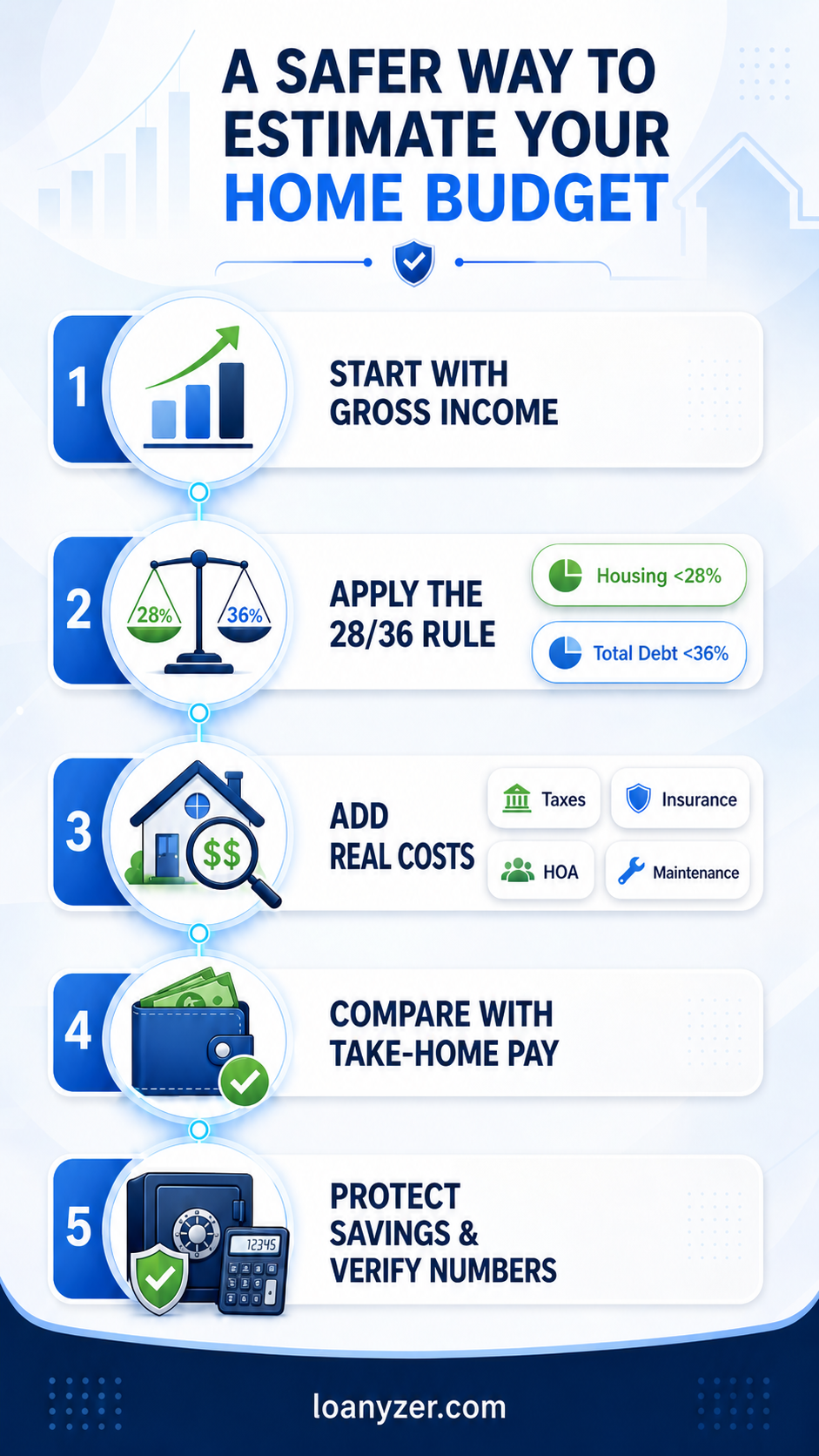
Use this process before you shop seriously:
- Start with your gross monthly income.
- Estimate a housing payment using the 28% rule.
- Calculate your total monthly debts using the 36% rule.
- Subtract existing debts to see what room is left for housing.
- Add property taxes, insurance, mortgage insurance, HOA fees, and location-specific coverage.
- Check the result against your take-home pay.
- Keep room for repairs, emergencies, and savings.
- Use a calculator to test different prices, down payments, rates, and terms.
- Compare real lender Loan Estimates before making a final decision.
Signs your mortgage budget may be too high
- You would have little or no emergency fund after closing.
- You are relying on future raises, bonuses, or overtime to make the payment comfortable.
- You cannot afford repairs without using credit cards.
- You would need to stop saving for retirement or other important goals.
- You are ignoring taxes, insurance, HOA fees, utilities, or maintenance.
- The payment only works if every other expense stays perfect.
When a lower home price may be the smarter choice
A lower home price can give you more flexibility. It may help you handle unexpected repairs, insurance increases, property tax changes, job changes, family costs, or future financial goals.
Buying slightly below your maximum can also make homeownership feel less stressful. The goal is not to impress a lender. The goal is to own a home without letting the payment control your life.
How this connects with DTI and mortgage pre-approval
Affordability rules of thumb are closely tied to debt-to-income ratio. If you want a deeper breakdown of how lenders compare housing costs and total debts, read mortgage affordability ratio and DTI.
If you are preparing to shop for homes, remember that pre-approval can help you understand a possible loan range, but it is not the same as a personal affordability decision. For context, read mortgage pre-approval vs pre-qualification.
Use the calculator after applying the rule of thumb
Rules of thumb are useful, but the real test is your full scenario. Use the Loanyzer mortgage affordability calculator to estimate how income, debts, down payment, interest rate, taxes, insurance, and loan term can affect your buying range.
Try at least three scenarios:
- A comfortable budget.
- A maximum approval-style budget.
- A conservative budget with higher taxes, insurance, or rate assumptions.
The best answer is not always the highest number. The best answer is the home price that lets you buy responsibly and still live comfortably.
Sources checked
This article was reviewed using the CFPB guide on figuring out whether you can afford a home, the CFPB homebuying budget guide, the CFPB debt-to-income ratio explainer, the CFPB Loan Estimate guide, and the Freddie Mac home affordability guide.
Bottom line
Mortgage affordability rules of thumb are helpful, but they are not enough. The 28/36 rule can give you a starting point, but real affordability depends on your debts, taxes, insurance, savings, repairs, take-home pay, local costs, and personal comfort level.
Do not buy the most expensive house a lender may approve. Aim for a home payment you can understand, afford, and maintain without sacrificing your financial safety.
