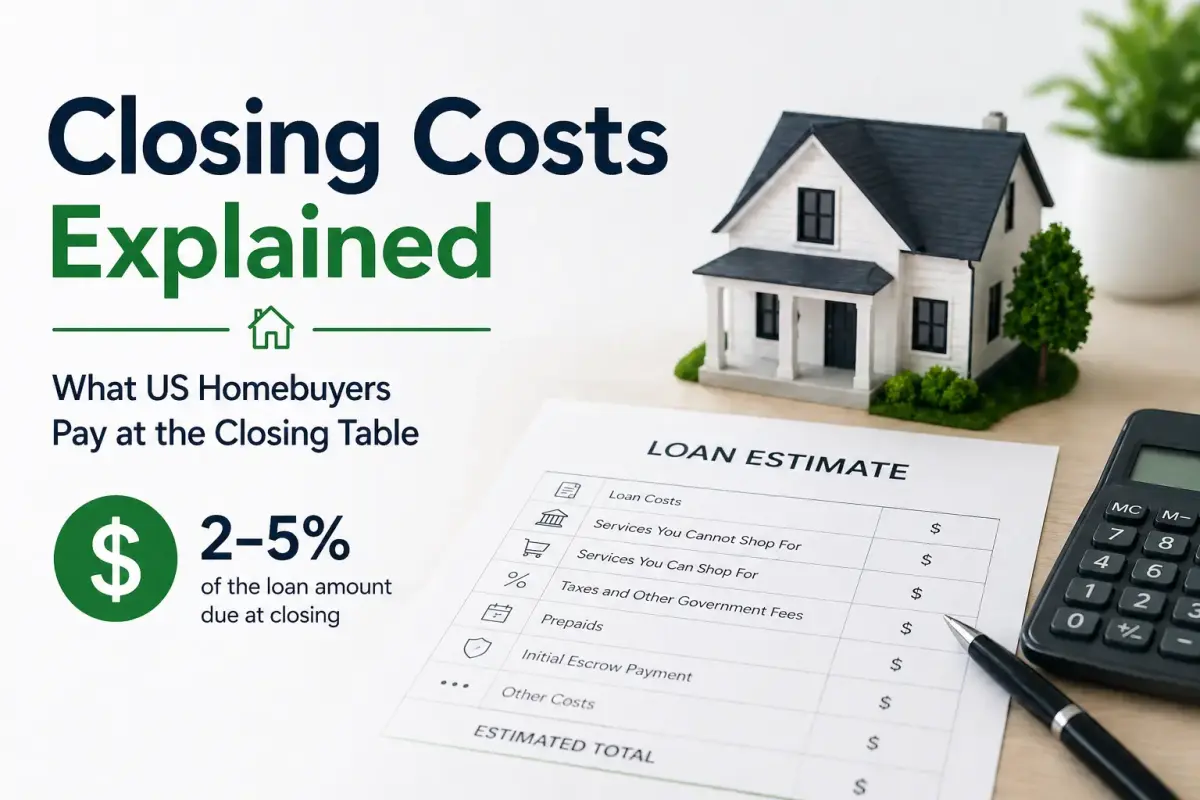
Reviewed May 2026. Closing costs are the upfront charges, prepaid items, and escrow deposits paid near the end of a home purchase, separate from the down payment. They can include lender fees, appraisal, title services, recording fees, prepaid homeowners insurance, property tax deposits, prepaid interest, and mortgage insurance items when applicable.
For many buyers, closing costs are the surprise that makes an otherwise affordable home feel suddenly tight. The smarter move is to estimate them early, compare them on the Loan Estimate, and keep enough cash after closing for repairs and the first months of homeownership.
Table of Contents
- Quick answer: what closing costs usually cover
- Closing costs are not the same as the down payment
- Where closing costs appear on the Loan Estimate
- Lender fees: what the lender charges
- Discount points: lower rate, higher upfront cost
- Third-party fees: services needed to close
- Prepaid items: costs collected before they are due
- Escrow setup: why lenders collect reserves
- How closing costs affect affordability
- Can closing costs be negotiated?
- Closing cost checklist for buyers
- How this fits with the rest of your mortgage plan
- Common mistakes to avoid
- Only saving for the down payment
- Comparing rates without comparing fees
- Assuming all closing costs are junk fees
- Arriving at closing without reading the documents
- Helpful resources used for this guide
- What to review before closing
Quick answer: what closing costs usually cover
| Cost group | Examples | Why it matters |
|---|---|---|
| Lender charges | Origination, underwriting, processing, discount points, credit report | These affect the cost of getting the mortgage itself. |
| Third-party services | Appraisal, title search, title insurance, settlement, recording, survey | These help verify value, ownership, and transfer of the property. |
| Prepaid items | Homeowners insurance, prepaid interest, property taxes | These are future costs collected upfront at closing. |
| Escrow reserves | Tax and insurance deposits | The lender may collect reserves to pay future bills from escrow. |
Closing costs are not the same as the down payment
The down payment reduces the amount you borrow. Closing costs pay for services, taxes, prepaid items, and account setup needed to complete the transaction. A buyer may have enough for a down payment and still be short on total cash to close if closing costs were not included in the plan.
That is why affordability should include more than the purchase price. Before making offers, test the full cash need using the Loanyzer mortgage affordability calculator and leave room for moving, repairs, and reserves.
Where closing costs appear on the Loan Estimate
The Loan Estimate is the main document buyers should use to compare mortgage costs. The CFPB explains that lenders provide a Loan Estimate after a mortgage application, and the form helps buyers review loan terms, projected payment, closing costs, and cash to close.
Do not rely only on a verbal quote, screenshot, or advertised rate. Ask lenders for Loan Estimates and compare them side by side. If one offer looks cheaper, check whether it uses discount points, lender credits, different tax assumptions, different insurance assumptions, or a different rate-lock period.
Lender fees: what the lender charges
Lender fees are charges connected to making and processing the mortgage. Names vary by lender, but common examples include origination charges, underwriting fees, processing fees, application fees, and credit report fees.
Some lender fees may be negotiable. Others may be built into the pricing. A lender may also offer a lender credit, which can reduce upfront closing costs in exchange for a higher rate. That can help cash flow at closing, but it may cost more over time if you keep the loan for many years.
Discount points: lower rate, higher upfront cost
Discount points are optional upfront charges paid to reduce the mortgage interest rate. One offer may have a lower rate because it includes points. Another may have a higher rate but lower cash to close.
The right choice depends on the break-even period. If paying points saves $80 per month but costs $3,200 upfront, the simple break-even is 40 months. If you may sell or refinance before then, points may not help. If you keep the loan longer, they may make more sense.
Third-party fees: services needed to close
Third-party fees go to companies involved in the transaction, not necessarily to the lender. These can include appraisal, title search, lender's title insurance, owner's title insurance, settlement or escrow fees, recording fees, transfer-related charges, attorney fees in some states, and surveys when required.
Some services are selected by the lender or required by the loan. Others may be services the buyer can shop for. The Loan Estimate separates certain costs so buyers can see which services may be shopped. If shopping is allowed, compare total service quality, timing, and price — not just the cheapest line item.
Prepaid items: costs collected before they are due
Prepaid items are not exactly fees. They are future costs collected at closing. Common examples include the first year of homeowners insurance, prepaid mortgage interest from the closing date to the end of the month, and property tax amounts depending on timing and local rules.
Prepaids can make cash to close look higher, but they are not always optional add-ons. They often reflect real ownership costs that would be due soon anyway. This is one reason two homes with the same price can require different cash at closing.
Escrow setup: why lenders collect reserves
Many mortgages use an escrow account for property taxes and homeowners insurance. The lender collects part of those costs with the monthly payment and pays the bills when due. At closing, the lender may collect escrow reserves so the account starts with enough money.
Escrow setup can surprise first-time buyers because it feels like paying taxes or insurance twice. In reality, one part may be a prepaid bill and another part may be reserves for future bills. Ask the lender or closing agent to explain each line before signing.
How closing costs affect affordability
Closing costs affect affordability in two ways. First, they increase the cash needed to buy. Second, if a buyer uses lender credits, rolls eligible costs into the loan, or chooses a higher rate to reduce upfront costs, the monthly payment and long-term cost can change.
This is where the cheapest-looking option can be misleading. A lower cash-to-close offer may have a higher monthly payment. A lower monthly payment may require more money upfront. Buyers should compare both the cash needed today and the cost over the time they expect to keep the loan.
Can closing costs be negotiated?
Some closing costs may be negotiable, but not all. A buyer may negotiate seller credits, compare lenders, ask about lender credits, shop for allowed third-party services, or choose whether paying points makes sense. Government taxes, recording fees, and some required services may be less flexible.
Seller credits can help buyers reduce upfront cash, but they are part of the offer negotiation. A seller may accept credits in a slower market and resist them in a competitive one. Also, loan programs can limit how much a seller can contribute.
Closing cost checklist for buyers
- Ask for Loan Estimates from more than one lender.
- Compare cash to close, not just monthly payment.
- Check whether the rate includes discount points.
- Ask which services you can shop for.
- Review lender credits and how they affect the rate.
- Separate one-time fees from prepaid items and escrow reserves.
- Keep emergency cash after closing.
- Compare the final Closing Disclosure before signing.
How this fits with the rest of your mortgage plan
Closing costs should be planned before pre-approval and revisited before closing. If you are still estimating your budget, start with how much house can I afford. If you are earlier in the process, read the first-time home buyer guide.
If you are comparing loan types, closing costs can differ between FHA and conventional loans, especially because of mortgage insurance and upfront charges. Review FHA vs conventional loan. If your next step is lender review, read mortgage pre-approval vs pre-qualification.
Common mistakes to avoid
Only saving for the down payment
The down payment is not the full cash requirement. Closing costs, prepaids, escrow reserves, moving, and early repairs can arrive quickly.
Comparing rates without comparing fees
A low rate can hide points or higher lender charges. Compare the full Loan Estimate.
Assuming all closing costs are junk fees
Some charges are negotiable or shop-friendly. Others pay for required services, government recording, taxes, insurance, or escrow setup.
Arriving at closing without reading the documents
Review the Closing Disclosure before closing and ask about changes from the Loan Estimate. Boring paperwork is where expensive surprises like to hide.
Helpful resources used for this guide
This review used consumer-protection resources, including CFPB Loan Estimate guidance, CFPB Closing Disclosure guidance, and CFPB guidance on HUD-1 and Closing Disclosure forms. Closing costs vary by lender, loan type, property, state, timing, and negotiation, so buyers should confirm exact amounts on their own Loan Estimate and Closing Disclosure.
What to review before closing
Before signing, make sure you understand cash to close, monthly payment, rate, APR, points, lender credits, prepaids, escrow reserves, title charges, and any changes from the Loan Estimate. If something looks different from what you expected, ask before closing — not after the keys are already in your hand.