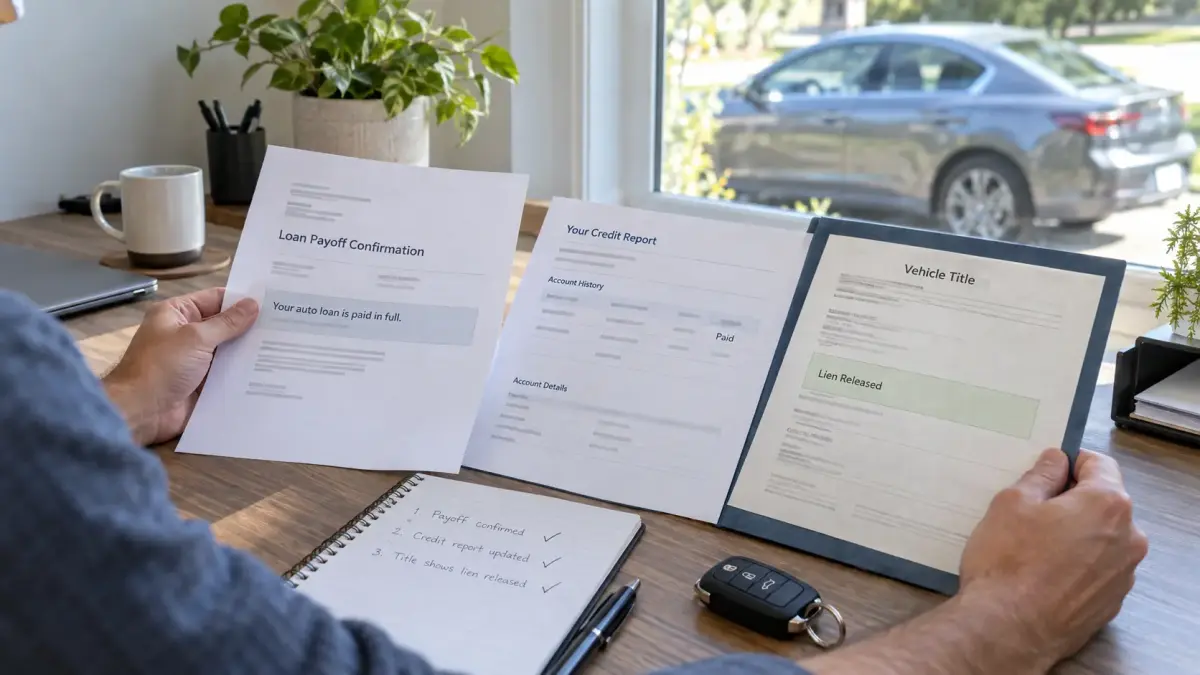
Paying the last dollar on a car loan closes a debt, but it does not necessarily erase the account from a credit report. The useful question is not simply, "Why is this still here?" It is, "Does each field accurately show what happened?" A closed auto loan with a zero balance can be normal history. An account that still appears open, carries a balance, shows a late payment you did not make, or belongs to someone else calls for a different response.
Start with the distinction that saves the most time: a visible closed account is not automatically an error. A wrong balance, status, date, payment history, owner, or duplicate tradeline may be.
This guide uses a three-record reconciliation: the lender's payoff ledger, the credit-report tradeline, and the vehicle title or lien record. They are connected, but one system updating does not prove the other two are correct.
Table of Contents
- What should a paid-off auto loan show?
- Reconcile three records before choosing an action
- 1. The lender payoff ledger
- 2. The credit-report tradeline
- 3. The title or lien record
- Two examples show why the classification matters
- Example 1: Closed and correct, but still visible
- Example 2: Payoff proof conflicts with the displayed balance
- Example 3: Credit reporting is correct, but the lien is unresolved
- Build a document-first verification file
- How should you dispute inaccurate post-payoff information?
- What if the account was transferred or appears twice?
- Before applying for new credit
- A practical decision path
What should a paid-off auto loan show?
Read the tradeline field by field. The label can vary among reports, so use the substance rather than one exact phrase. Check whether the account is described as closed or paid, whether the current balance is zero, whether the payment history matches your records, and whether the lender and account belong to you. Also note the date the information was last reported. The Consumer Financial Protection Bureau's credit-report resources explain how to obtain, review, and act on report information.
| What you see | Likely classification | Best next check |
|---|---|---|
| Closed or paid, zero balance, history matches | Potentially normal closed history | Keep your payoff records and check the other reports |
| Open status shortly after payoff, with an older reporting date | Possible timing or furnishing lag | Compare dates and contact the lender or furnisher |
| Remaining balance after documented payoff | Possible inaccurate or incomplete data | Reconcile the final ledger, then document a dispute if needed |
| Late marker that conflicts with statements | Possible payment-history error | Match the exact month to statements and payment proof |
| Same debt appears twice | Possible duplicate or transferred-account issue | Compare account numbers, dates, owners, and balances |
| Credit report is correct but title still shows a lien | Separate title or lien issue | Follow up with the lender and motor-vehicle authority |
Reconcile three records before choosing an action
1. The lender payoff ledger
The lender's record should show how the final payoff was calculated and applied. Keep the payoff quote, confirmation number, payment proof, account statement, and any paid-in-full letter. A payoff quote can include amounts that a normal statement balance does not capture, such as interest through a stated date. If you are still at that stage, Loanyzer's auto loan payoff quote guide explains why the quote, not the ordinary balance, is the starting document.
2. The credit-report tradeline
A credit report is not the lender's live account screen. Compare every available report because a lender may furnish to more than one reporting company and the displayed fields may not look identical. Use AnnualCreditReport.com, the federally authorized source, rather than relying only on a score app's summary.
3. The title or lien record
Payoff and lien release are related but separate. A credit report can show a zero balance while a paper or electronic title record still needs action. Conversely, a released lien does not correct an inaccurate tradeline. Ask the lender how it handles the release and confirm the process with the motor-vehicle authority that controls the title. Procedures differ by jurisdiction, so this article does not assume one form or deadline applies everywhere.
- Lender ledger: proves how the debt was paid and what the lender recorded.
- Credit-report tradeline: shows what a reporting company displays to users of that report.
- Title or lien record: shows the secured-interest status tied to the vehicle.
Treat a mismatch in the system where it appears. Do not assume one correction automatically fixes all three.
Two examples show why the classification matters
Example 1: Closed and correct, but still visible
Suppose Maya's final payment cleared on August 5. Her lender confirmation shows the loan paid in full. A report downloaded later shows a zero balance, a closed status, and payment history that matches her statements. The account's continued appearance may be accurate closed history. Maya keeps the documents, checks her other reports, and does not file a dispute merely to make the account disappear.
Example 2: Payoff proof conflicts with the displayed balance
Suppose Andre's payoff confirmation shows $18,420 received and a zero lender balance. One report later displays the account as open with $1,842 remaining. The difference is not a harmless label: the digits also suggest a possible data-entry or transmission issue. Andre records the report date, asks the lender to confirm the furnished balance, and builds a dispute file around the exact incorrect fields. He does not claim that every part of the account should be deleted.
Example 3: Credit reporting is correct, but the lien is unresolved
Suppose Priya's reports show a closed account and zero balance, but the title record still lists the lender. A credit-report dispute would target the wrong system. Priya follows up on the lien-release process using her payoff documents and the applicable motor-vehicle channel.
Build a document-first verification file
- Save the payoff quote and its valid-through date.
- Save proof of the final payment and the lender's payoff confirmation.
- Download each available credit report and preserve the complete tradeline.
- Write down the balance, status, last-reported date, payment-history month, and account owner shown by each report.
- Keep title and lien-release documents in a separate section of the file.
- Describe the suspected error in one sentence and identify the document that contradicts it.
A precise claim is easier to investigate than a broad request to "remove the loan." For example: "The report shows a current balance of $1,842 and an open status, while the lender's August 5 payoff confirmation and August 6 account statement show a zero balance and paid-in-full status." Redact information only where doing so does not prevent the recipient from matching the account and evidence.
How should you dispute inaccurate post-payoff information?
If the comparison identifies information you believe is inaccurate or incomplete, follow the reporting company's instructions and consider notifying the company that furnished the information. The official guide to disputing a credit-report error describes both paths. The Federal Trade Commission's dispute guide also explains what to include and why copies and records matter.
- Name the exact field: balance, open or closed status, payment history, account owner, dates, or duplicate reporting.
- Attach supporting copies: use payoff confirmation, statements, payment proof, identity material when required, and the relevant report page.
- Dispute with each affected reporting company: one report's result does not prove every other report has the same data.
- Contact the furnisher: give the lender or servicer the same precise description and evidence.
- Keep a dated trail: retain what you sent, where you sent it, delivery evidence, reference numbers, responses, and revised reports.
- Read the result, not just the subject line: confirm which fields changed and whether another mismatch remains.
Do not send irreplaceable originals. Preserve your payoff and title documents. Use readable copies and keep the full file until the lender record, affected reports, and lien status are reconciled.
What if the account was transferred or appears twice?
A transfer can create two tradelines without automatically meaning the same balance is being counted twice. Compare the original creditor and new owner, account-number fragments, open and close dates, reported balances, and narrative fields. The key question is whether the history accurately shows a transfer or whether two records incorrectly represent the same current obligation.
This is also where post-payoff reporting differs from an unresolved charge-off. A charged-off auto loan can involve continuing collection, lien, or repossession exposure. Loanyzer's charged-off car loan guide covers that distinct situation. Do not use a payoff workflow when the underlying debt is still disputed or unresolved.
Before applying for new credit
If you plan to finance another vehicle soon, review the reports before the application rather than assuming payoff made the old account vanish. A prospective lender may evaluate the full file and may use a different report or scoring model from a consumer app. Correcting inaccurate information does not guarantee a score increase, rate, approval, or timing outcome.
If the old account still shows a material balance or open status, ask whether the new lender can review your payoff confirmation while the reporting issue is being handled. Also update your own budget. The old payment may be gone, but the next loan still has to fit alongside insurance, taxes, registration, maintenance, and other debts. Loanyzer's car finance planning hub can help you compare the next borrowing decision without treating a monthly payment as the whole cost.
A practical decision path
- Closed, zero balance, accurate history: keep records and monitor; visibility alone may not justify a dispute.
- Recently paid, older reporting date: document dates and ask the lender when it last furnished information without assuming a guaranteed update date.
- Wrong balance, status, history, owner, or duplicate: assemble evidence and use the official dispute channels for each affected report and the furnisher.
- Correct report, unresolved lien: use the lender and motor-vehicle process rather than a credit-report dispute.
- Debt itself is unresolved: identify the creditor, balance, and legal status before treating the account as a routine paid-off reporting issue.
The goal is not to force every closed auto loan off a report. It is to make sure the record tells the truth: the debt was paid, the displayed balance and status are accurate, the payment history belongs to you, and the lien-release process is separately complete. Classify the mismatch first, then send the right evidence to the right system.