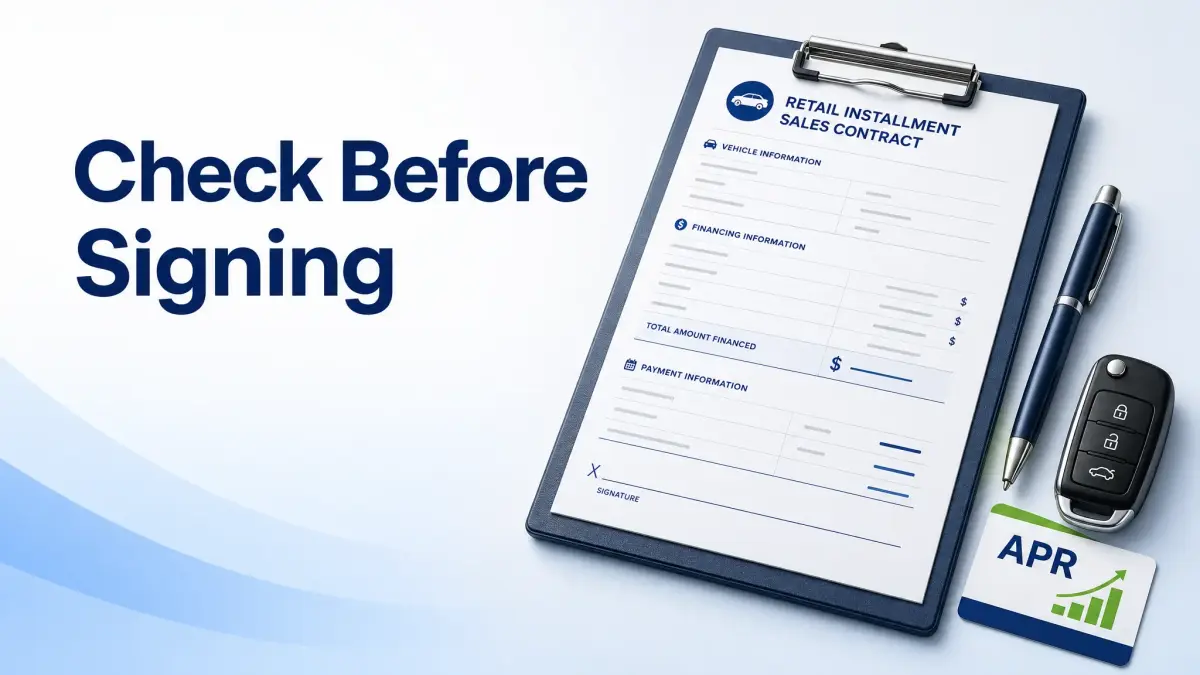
Retail installment sales contract car paperwork is where a dealer's price, financing terms, add-ons, trade-in, down payment, taxes, fees, APR, finance charge, and total sale price become one signed obligation. The payment matters, but the contract is the document that tells you what you are actually agreeing to repay.
This guide explains what a retail installment sales contract does, how it differs from a buyer order or purchase agreement, which numbers should match before you sign, and when a shopper should pause the deal long enough to get written answers.
The monthly payment is not the contract. The contract is the math behind the payment.
Table of Contents
- What is a retail installment sales contract?
- Follow the financing from dealer to payment servicer
- Buyer order vs retail installment contract vs TILA disclosure
- Why can the contract change the real deal?
- Contract math to reconcile line by line
- Red flags before you sign
- How does preapproval change the conversation?
- What should you do if you already signed and something looks wrong?
- Bottom line
What is a retail installment sales contract?
A retail installment sales contract is commonly used when a dealer sells a vehicle and lets the buyer pay over time. A federal consumer resource describes a retail installment sales contract as an agreement where the seller lets the buyer repay the purchase price over time, often with finance charges.
In many dealer-arranged financing deals, the dealer signs the contract with you and then assigns it to a bank, credit union, captive finance company, or other lender. That assignment can happen after you leave the finance office, but the signed terms still matter because they are the baseline for your payment schedule and total cost.
Follow the financing from dealer to payment servicer
Retail installment financing starts as a credit sale with the dealer, not as money you borrow directly from a bank before shopping. The Consumer Financial Protection Bureau explains that the dealer will typically sell the completed contract to a bank, credit union, or finance company. A buy-here-pay-here dealer may keep the contract instead.
That handoff does not turn the purchase into a different bargain. Your completed contract remains the starting record for the vehicle price, amount financed, APR, finance charge, payment schedule, and other signed terms. What may change is the company that owns or services the account and tells you where to pay.
| Stage | Who to identify | Document check |
|---|---|---|
| At signing | The dealer shown as seller or original creditor | Keep the fully completed contract and match its price, credit terms, first due date, and payment count to the deal you approved. |
| After assignment | The bank, credit union, or finance company that acquired or services the contract | Match any welcome letter or payment instruction to the contract, vehicle, account number, due date, and official contact information. |
| Before first payment | The verified payment recipient | Confirm the payment channel through the signed paperwork or the company's official website. Do not redirect a payment only because of an unexpected call, text, or email. |
- Is the financing fully approved, or is the dealer still trying to place the contract?
- Which company is named on the completed contract, and does it contain an assignment clause?
- Who will send the first verified payment instructions if the contract is assigned?
- If the financing is not final, what happens to the car, down payment, and trade-in if the proposed lender does not accept the terms?
The Federal Trade Commission's dealer-financing guidance advises buyers to ask whether the terms are final and fully approved before signing and driving away. If the dealer says approval is still in progress, consider waiting with your current car until the financing is final. If you are later asked to return and sign different terms, compare the entire replacement deal before agreeing.
Assignment should change where a verified payment goes, not erase your need for a complete signed contract or justify unexplained replacement terms.
Buyer order vs retail installment contract vs TILA disclosure
Dealers may use several documents during the sale. Names vary by state and dealer system, so focus on purpose. A buyer order or purchase agreement usually lays out the vehicle price and sale items. A retail installment sales contract turns the financed purchase into repayment terms. Truth in Lending Act disclosures explain the cost of credit, including APR and finance charge, and federal auto loan materials encourage borrowers to compare the full terms, not only the payment.
| Document | What it usually shows | What to compare before signing |
|---|---|---|
| Buyer order or purchase agreement | Vehicle, VIN, negotiated price, taxes, title, registration, dealer fees, add-ons, trade-in, and down payment. | Match the cash price, fees, add-ons, trade-in allowance, trade payoff, and out-the-door price. |
| Retail installment sales contract | Amount financed, APR, finance charge, payment schedule, total of payments, and total sale price. | Confirm the financed balance, APR, term, payment date, add-ons, and total cost. |
| TILA disclosure section | Standardized credit-cost disclosures such as APR, finance charge, amount financed, and total of payments. | Compare APR to APR when evaluating offers, not APR to a quoted interest rate or monthly payment. |
If you need a deeper disclosure walkthrough, Loanyzer's Truth in Lending disclosure guide explains the APR, finance charge, amount financed, and total of payments in a car loan context.
Why can the contract change the real deal?
A shopper can negotiate one price and still sign a different overall deal if the finance office adds optional products, changes the term, adjusts the APR, rolls negative equity, changes trade-in payoff handling, or conditions the advertised price on dealer financing. A federal consumer-protection agency warned auto dealership groups in March 2026 about deceptive pricing issues, including advertised prices that exclude required fees, unavailable rebates, financing conditions, and nonexistent vehicles; that context makes written price comparison especially important. Read this deceptive auto pricing warning for the official consumer-protection backdrop.
Federal consumer guidance on buying a new or used car also emphasizes getting terms in writing and understanding fees before signing. That does not mean every fee is illegal. It means required charges, optional products, financing conditions, and rebate assumptions should be visible before they are folded into a financed balance.
If a fee is mandatory, it belongs in the price conversation before you sign, not as a surprise inside the financed amount.
Contract math to reconcile line by line
Use the contract as a math audit. Start with the vehicle's cash price, then move through taxes, title, registration, dealer fees, optional add-ons, trade-in allowance, trade payoff, down payment, rebates, and the final amount financed. Then read the credit terms: APR, finance charge, payment schedule, total of payments, and total sale price.
| Contract line | Why it matters | What to ask if it changed |
|---|---|---|
| Cash price or selling price | It anchors taxes, financed balance, and comparison shopping. | Why is this different from the advertised or negotiated price? |
| Dealer fees and required charges | Mandatory fees can raise the real out-the-door price. | Which fees are required by law, which are dealer charges, and were they disclosed before financing? |
| Add-ons and service products | GAP, warranties, service contracts, maintenance, theft products, or protection packages may increase amount financed. | Which items are optional, cancellable, already included, or required by the lender? |
| Trade-in allowance and payoff | A payoff gap can create negative equity in the new contract. | Is the payoff current, and who sends payment to the prior lender? |
| Amount financed | This is the balance used for repayment after credits and charges. | Which added items explain the difference from the vehicle price? |
| APR, finance charge, and term | These lines show the cost of credit and how long repayment lasts. | Did the APR, term, or payment schedule change from the offer you compared? |
When the amount financed or APR changes, run the new numbers before signing. Loanyzer's car loan calculator can help you compare the payment and total interest at different amounts, APRs, and terms. For add-on decisions, use the auto loan add-ons guide to separate products you actually want from products that only make the payment look slightly different.
Red flags before you sign
- Match the VIN, year, trim, mileage, and vehicle condition to the car you inspected.
- Compare cash price and out-the-door price against the buyer order.
- Confirm taxes, title, registration, dealer fees, and required charges.
- Mark every add-on as accepted, declined, optional, required, cancellable, or noncancellable.
- Verify trade-in allowance, payoff amount, payoff deadline, and negative equity treatment.
- Compare APR, finance charge, term, first payment date, payment schedule, total of payments, and total sale price.
- Ask for a copy of every signed document before leaving the dealership.
Slow down if the dealer asks you to sign blank financing fields, says the APR does not matter because the payment fits, refuses to itemize add-ons, changes the term without explaining why, or says the documents can be corrected later. A rushed signature can be harder to unwind than a delayed purchase.
Do not sign blank financing fields to hold a car. A blank today can become a binding number later.
How does preapproval change the conversation?
An outside preapproval from a bank, credit union, or online lender can give you a comparison point before the dealer controls the financing conversation. It does not guarantee that dealer financing will be worse, and it does not guarantee approval on the final vehicle. But it helps you compare APR, term, amount financed, fees, and total payments with less pressure.
Use Loanyzer's auto loan preapproval guide before the finance office, then review how to compare auto loan offers if the dealer presents a different APR, longer term, rebate condition, or add-on package.
What should you do if you already signed and something looks wrong?
Start by gathering the signed retail installment sales contract, buyer order, add-on contracts, trade-in paperwork, payoff quote, lender assignment notice, insurance documents, and payment schedule. Write down what changed and what the dealer said before signing. Then contact the dealer or assigned lender in writing and ask for the specific correction or explanation.
Rules on cancellation rights, add-on refunds, dealer conduct, notices, and remedies can vary by state and contract language, so this article is not legal advice. If the issue involves misrepresentation, undisclosed fees, blank documents, forged information, or a serious dispute, consider contacting your state attorney general, state motor vehicle regulator, legal aid, or a qualified attorney. The federal consumer page on finance and insurance departments can also help you understand the role of the dealer's F&I office.
Bottom line
A retail installment sales contract should make the deal clearer, not more mysterious. Before signing at the dealer, compare the contract to the buyer order, verify the cash price and required fees, decide on add-ons before they are financed, check APR and finance charge, and run the final amount financed through a payment calculator. If the numbers do not match the deal you understood, pause long enough to get a written explanation.