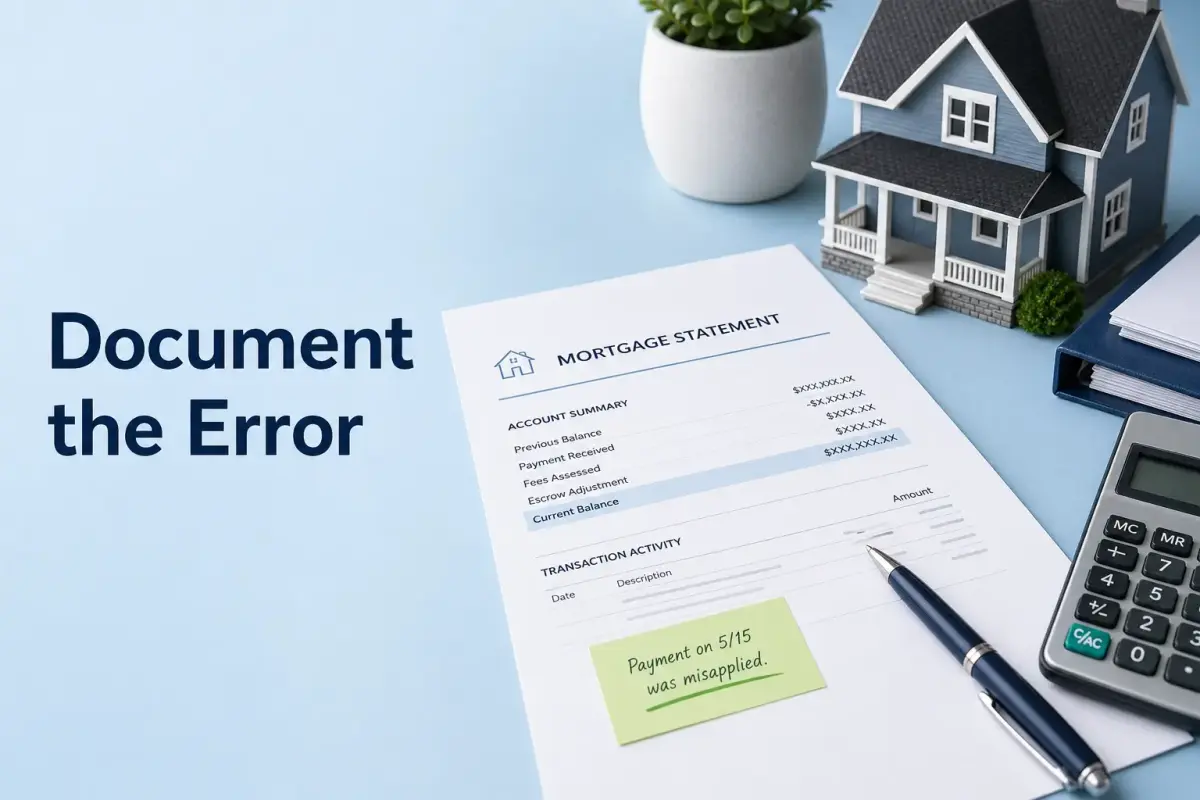
A mortgage notice of error is a written way to tell your mortgage servicer that something specific may be wrong with your account, such as a payment that was not credited correctly, an escrow calculation that does not match your records, an unexpected fee, a payoff balance problem, or a force-placed insurance issue. The practical goal is not to sound legalistic. The goal is to create a clear paper trail that tells the servicer what happened, what evidence you have, and what correction or explanation you want.
This guide explains when a Notice of Error fits, when a Request for Information may be better, what to include, what to keep paying, and how to escalate calmly if the servicer's answer does not resolve the problem.
Continue making your mortgage payments as scheduled while the dispute is reviewed. Sending a Notice of Error does not suspend your payment obligations; paying only an undisputed portion may leave the account delinquent.
Table of Contents
- When should you send a mortgage notice of error?
- Notice of Error vs Request for Information vs QWR
- Use the correct servicer address
- What should you include in the letter?
- What should you keep paying while the dispute is open?
- How should you organize the evidence?
- Common servicer issues and the best proof to attach
- What happens after you send it?
- When should you escalate beyond the servicer?
- Bottom line
When should you send a mortgage notice of error?
Send a Notice of Error when you can identify a specific servicing problem and you want the servicer to investigate or correct it. The CFPB guidance on disputing a mortgage servicer error describes the basic distinction between disputing an error and requesting information. A Notice of Error is usually the stronger fit when you are saying, in effect, “this account activity appears wrong, and here is why.”
Common examples include:
- a monthly payment was received but not credited correctly;
- the servicer applied extra money to the wrong place, such as escrow instead of principal;
- a late fee appeared even though your records show timely payment;
- the escrow analysis seems to use the wrong tax or insurance number;
- the payoff statement, reinstatement amount, or loan balance appears inconsistent;
- force-placed insurance was charged even though you had active coverage;
- a servicing transfer caused missing records, payment confusion, or duplicate fees.
If the problem is mainly that you need documents, calculations, payment history, or the name of the loan owner, a Request for Information may fit better. Many homeowners send both ideas in one careful letter, but it should still be organized: identify the suspected error, then separately ask for the documents or records needed to understand it.
Notice of Error vs Request for Information vs QWR
Mortgage servicing language can feel confusing because several terms overlap. The table below keeps the decision practical.
| Tool | Best fit | What to ask for | Common mistake |
|---|---|---|---|
| Notice of Error | You believe the servicer made a specific mistake. | Correction, investigation, fee reversal, payment crediting, escrow review, or explanation of the account error. | Sending a vague complaint without dates, amounts, or proof. |
| Request for Information | You need records before you can confirm what happened. | Payment history, escrow analysis, payoff calculation, servicing transfer records, insurance records, or account notes. | Asking broad questions instead of requesting identifiable documents. |
| Qualified Written Request (QWR) | A written RESPA-style servicing request that may include error disputes and information requests. | Specific servicing-related corrections or records tied to the loan account. | Assuming any letter to any address automatically triggers the same handling. |
Use the correct servicer address
The address matters. Your payment address may not be the same as the designated address for Notices of Error, Requests for Information, or written account disputes. The Regulation X error-resolution rule is the federal servicing rule that governs many error-resolution duties, but homeowners still need to send the request to the right place and keep proof that it was delivered.
Look for the written notice address on your monthly statement, servicer website, welcome/transfer letter, escrow notice, or customer service correspondence. If you call to confirm the address, write down the date, time, representative name or ID if available, and exactly what address was given.
Use the servicer's designated error or information-request address, which may be different from the address used for monthly payments.
What should you include in the letter?
Your letter should be easy for a servicing team to route, investigate, and answer. Include enough detail to reduce ambiguity without burying the issue in unrelated history.
- Borrower name and co-borrower name, if applicable.
- Loan number and property address.
- Current mailing address, phone number, and email.
- A clear subject line, such as “Notice of Error and Request for Information.”
- The exact error you believe occurred.
- Important dates, amounts, check numbers, confirmation numbers, or escrow figures.
- Copies of proof, not originals.
- The correction or records you are requesting.
- A request for written confirmation after the review is complete.
For example, if a payment was not credited, attach bank proof, confirmation numbers, a copy of the statement showing the missing credit, and any servicer message that confirms receipt. If the issue is escrow, attach the escrow analysis, the tax bill or insurance declaration page, and your prior statement. The Loanyzer escrow shortage guide can help you separate a real tax or insurance increase from a possible calculation problem.
What should you keep paying while the dispute is open?
Mortgage disputes can become more expensive when the borrower stops paying everything out of frustration. Even when the servicer is wrong, late charges, delinquency reporting, or loss mitigation stress can grow if the account falls behind. The FTC guidance on mortgage payment rights is a useful reminder that borrowers should understand payment rights and records, but it does not turn a dispute into permission to ignore current obligations.
Continue making the full scheduled mortgage payment while the dispute is reviewed, keep proof of every payment, and ask the servicer in writing how it is applying the funds. A partial payment may be returned or held in a suspense account rather than credited as a full periodic payment; confirm the servicer's policy. The servicer cannot require payment as a condition of investigating a covered Notice of Error, but the notice does not cancel your obligation to pay. If the disputed amount is large, if foreclosure has started, or if you cannot safely make the payment, talk to a HUD-approved housing counselor or qualified local attorney quickly. This article is educational and is not legal advice.
How should you organize the evidence?
A written timeline usually beats a long phone history. Start with a one-page timeline that lists dates, documents, payment amounts, statement balances, escrow changes, phone calls, and letters sent. Then attach only the proof that supports the timeline.
For servicing-transfer problems, compare the old servicer's final statement with the new servicer's first statement and payment instructions. The Loanyzer mortgage servicing transfer guide explains why transfer timing can create confusion even when the underlying loan terms have not changed. For force-placed insurance, compare the servicer notice with your insurance declarations page and payment proof; the force-placed insurance guide explains why coverage gaps and evidence timing matter.
Common servicer issues and the best proof to attach
| Issue | Useful proof | Related Loanyzer guide |
|---|---|---|
| Payment not credited or credited late | Bank statement, confirmation number, canceled check, payment portal receipt, monthly statement. | mortgage payment breakdown |
| Escrow shortage or surplus appears wrong | Escrow analysis, tax bill, insurance renewal, prior escrow statement. | escrow shortage guide |
| Tax estimate changed after purchase | County tax record, reassessment notice, closing disclosure, escrow projection. | property tax reassessment |
| Force-placed insurance charge | Declarations page, insurer payment receipt, cancellation/reinstatement notice, servicer notice. | force-placed insurance guide |
| Payoff or closing-related balance question | Payoff statement, closing disclosure, wire confirmation, lender or title correspondence. | cash to close and closing costs guide |
What happens after you send it?
The servicer should review the request and respond under the applicable servicing rules. Timelines can vary depending on the type of request, whether the request went to the right address, and whether the issue falls within the covered servicing categories. The CFPB overview of federal mortgage servicing rules is a good starting point for understanding that federal rules exist, but you should avoid assuming every situation has the same deadline or remedy.
For a covered Notice of Error under Regulation X, the general deadlines run from receipt and exclude Saturdays, Sundays and legal public holidays:
- Acknowledgment: generally within 5 days.
- Investigation and written response: generally within 30 days; an additional 15 days may be available if the servicer explains the extension in writing before the original period ends.
- Important exceptions: an inaccurate payoff-balance error generally has a 7-day response deadline. Covered foreclosure errors generally require a response before the sale or within 30 days, whichever comes first; the 15-day extension does not apply to those errors or payoff-balance errors. A foreclosure notice received 7 or fewer days before sale has a different good-faith response rule. Early correction, duplicate, overbroad or untimely notices can also change the duties.
These are Notice of Error deadlines, not a guarantee that foreclosure stops or that every Request for Information follows the same timetable. Get qualified help promptly if a sale or other legal deadline is approaching.
Keep a copy of the letter, every attachment, the mailing receipt, tracking confirmation, and any response. If the servicer asks for more information, answer in writing and keep that proof too. If the servicer corrects the account, ask for an updated statement or written confirmation showing the correction.
When should you escalate beyond the servicer?
If the servicer does not respond, gives an answer that does not address the documented issue, or the problem creates urgent risk, escalation may be appropriate. Possible next steps include filing a complaint through the CFPB complaint portal, contacting a HUD-approved housing counselor, speaking with a local attorney, or contacting a state regulator where appropriate.
Escalate faster if there is foreclosure risk, bankruptcy, active loss mitigation, a large payment dispute, suspected credit reporting damage, or a deadline you do not understand. A web article cannot tell you how to protect a home in an urgent legal situation; the practical move is to get help before the timeline gets tighter.
Bottom line
A mortgage notice of error works best when it is specific, documented, and sent to the correct address. Keep making scheduled mortgage payments, avoid relying only on phone calls, preserve every record, and separate the suspected error from the documents you need to verify it. The calmer and clearer your written record is, the easier it becomes for the servicer or an outside reviewer to see what needs to be fixed.