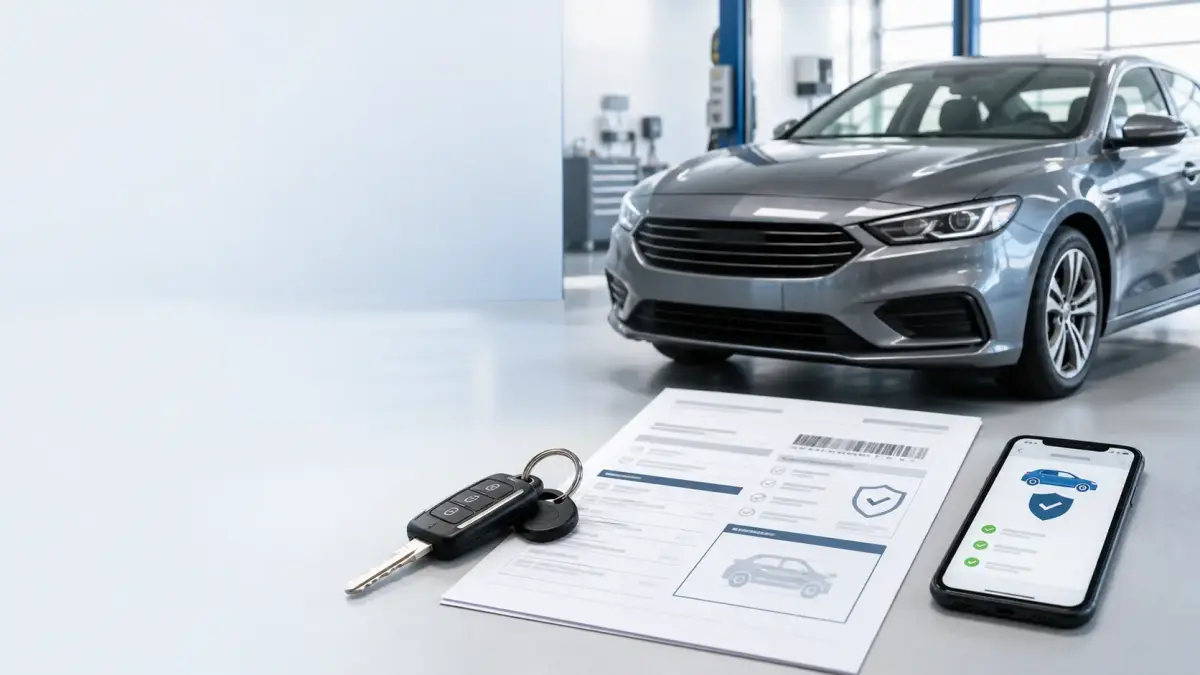
If you plan to buy a used car with an open recall, slow the financing process down. A lender can approve the loan, the seller can quote a manageable payment, and the vehicle can still need an unrepaired safety remedy. The useful question is not simply whether the recall exists. It is whether you can verify the exact VIN, understand the safety instructions, confirm when the remedy will be available, and keep the loan from closing before those facts are clear.
Table of Contents
- What does an open recall result actually tell you?
- Why does loan approval not clear the recall?
- Can a used-car dealer sell a vehicle with an open recall?
- What should you verify before financing?
- Proceed, wait, or walk away?
- A simple total-cost example
- What should be written into the deal?
- What if you discover the recall after signing?
- Final before-signing checklist
- The bottom line
What does an open recall result actually tell you?
Start with the official NHTSA recall lookup. A VIN or license-plate search can show whether a specific vehicle has an unrepaired recall. If the result says there are no unrepaired recalls associated with the VIN, that is useful evidence, but it is not a lifetime guarantee.
NHTSA also explains important limits. The lookup may not show a recently announced recall before all affected VINs are identified, recalls older than 15 years in many cases, some small-manufacturer campaigns, non-safety service campaigns, international vehicles, or repairs that have already been completed. That is why a careful buyer saves the result and also calls an authorized dealer for the vehicle's manufacturer.
A recall result is a checkpoint, not a complete vehicle condition report. It does not replace an independent inspection, title review, history report, insurance quote, or loan comparison.
Why does loan approval not clear the recall?
An auto lender decides whether to extend credit under its own underwriting and collateral rules. Unless the lender gives you a specific written recall confirmation, approval should not be read as proof that the safety remedy was completed or that parts are available. The same separation applies to an insurance binder: it can prove coverage is ready, but it does not prove the recall file is closed.
The FTC's used-car guidance treats financing, the Buyers Guide, vehicle history, independent inspection, and recall research as separate checks. That is the right mental model: each document answers a different question.
| Evidence | What it can help prove | What it does not prove by itself |
|---|---|---|
| NHTSA VIN result | Whether the current lookup shows an unrepaired safety recall for that VIN | Complete mechanical condition, title status, or immediate parts availability |
| Authorized dealer confirmation | Recall campaign, remedy status, parts availability, and appointment timing | The seller's promises or your right to cancel the purchase |
| Vehicle history report | Reported title, accident, ownership, and service events | Every mechanical problem or every current recall detail |
| Independent inspection | Observed condition and repair concerns at the time of inspection | That a manufacturer recall campaign is officially completed |
| Loan approval | That a lender is willing to finance under stated conditions | Recall completion, repair timing, or safe use |
| Insurance binder | That specified coverage is arranged | Recall closure or warranty coverage |
Can a used-car dealer sell a vehicle with an open recall?
Be careful with universal answers. Federal recall rules expressly address delivery of a new motor vehicle by a dealer before the defect is remedied. The current 49 CFR 577.13 dealer-notice rule uses that new-vehicle language. Used-vehicle disclosure, sale, warranty, and remedy questions can also depend on state law, the seller's written representations, the contract, and the facts of the transaction.
For a buyer, the practical move is stronger than debating a broad legal slogan at the finance desk: ask the seller to identify the recall in writing, confirm whether the remedy is complete, and state who will handle it and when. If the answer changes, stop the funding process until the documents agree.
What should you verify before financing?
- Copy the VIN from the vehicle. Compare the windshield VIN with the title, buyer's order, history report, insurance documents, and loan paperwork.
- Run the official lookup. Save a dated screenshot or PDF of the result so you know what information you relied on.
- Read the recall notice. Identify the affected component, manufacturer instructions, and any warning not to drive, park, charge, or use the vehicle in a certain way.
- Call an authorized dealer. Give the service department the VIN and ask whether the remedy exists, whether parts are available, and the earliest realistic appointment.
- Get the seller's plan in writing. Record whether the repair will happen before delivery, whether the sale will wait, and what happens to a deposit if the remedy is delayed.
- Keep the inspection separate. A recall repair does not replace an independent inspection of the rest of the car.
- Price the complete deal only after the vehicle clears the decision. Use the Loanyzer car loan calculator with the written out-the-door price, down payment, APR, and term.
Proceed, wait, or walk away?
| Situation | Practical response | Financing boundary |
|---|---|---|
| Remedy completed and documented | Verify the VIN result or repair record, then continue the normal inspection and price review | Compare offers using the same amount financed and term |
| Remedy available before delivery | Require completion and written proof before accepting the car | Do not fund based only on a verbal appointment promise |
| Parts delayed but interim guidance allows use | Decide whether the delay, transportation needs, and seller terms are acceptable | Do not assume the lender, seller, or insurer covers disruption costs |
| Manufacturer says not to drive or use the vehicle | Follow the safety instruction and choose a different timeline or vehicle | Do not close a loan for transportation you cannot use as planned |
| Seller refuses VIN or written recall details | Pause or leave the deal | Do not let payment pressure replace missing evidence |
A simple total-cost example
Suppose a buyer is considering a $24,000 used car financed for 60 months at an illustrative 8% APR. The payment is about $487 per month and total interest is about $5,200 before taxes, fees, optional products, and lender-specific rounding. Those numbers can look manageable.
Now add an unrepaired recall with no confirmed parts date. If the buyer needs the car for work next week, the real decision includes temporary transportation, deposit risk, a trade-in already surrendered, and whether payments could begin before the car is usable as expected. A free manufacturer remedy may solve the repair cost, but it does not automatically solve timing or disruption.
Run the loan only after the vehicle decision is sound. Then compare the dealer offer with an outside quote using the same APR, finance-charge, term, and total-cost fields.
What should be written into the deal?
Verbal assurances are weak evidence. Ask for the VIN, recall campaign, repair responsibility, expected completion, deposit treatment, delivery condition, and any seller promise in the buyer's order or another signed document. Federal consumer guidance advises used-car buyers to get promises in writing and to read the Buyers Guide and warranty language carefully.
- Do not sign a blank or incomplete repair promise.
- Do not let the seller substitute a service contract for a manufacturer recall remedy without explaining the difference.
- Do not surrender your trade-in until financing and delivery conditions are final and documented.
- Do not accept a changed APR, longer term, extra down payment, or added product as the price of waiting for recall work.
- Ask for the complete out-the-door price before discussing only the monthly payment.
What if you discover the recall after signing?
First, follow any interim safety instruction in the recall notice. NHTSA tells owners to contact a local authorized dealership for the free remedy. Save the lookup result, recall notice, purchase documents, Buyers Guide, repair appointments, and every written conversation with the seller.
Contact the seller and the manufacturer's authorized dealer promptly, but do not assume there is a universal three-day cancellation period. Federal consumer guidance explains that the law does not generally require a dealer to give buyers three days to cancel and return a car; state rules and a dealer's written return policy may differ. If the seller made a specific written safety, inspection, or repair promise, preserve that wording when you seek consumer or legal help.
Do not stop paying the auto loan solely because a recall dispute is unresolved. The loan contract and the recall remedy are separate obligations unless you receive qualified advice or a written agreement that says otherwise.
Final before-signing checklist
- VIN matches the car, title, buyer's order, insurance, and loan documents.
- NHTSA lookup result is saved and dated.
- Recall notice and interim safety instructions are understood.
- Authorized dealer confirms remedy and parts status.
- Seller's repair and delivery plan is written.
- Independent inspection and vehicle history are reviewed separately.
- Deposit and trade-in treatment are documented if the repair is delayed.
- Out-the-door price, APR, term, finance charge, and total of payments are final.
- Insurance requirements and likely transportation costs fit the budget.
- You are willing to walk away if the vehicle or paperwork remains unclear.
The bottom line
An open recall does not automatically make every used car the wrong purchase, and a free remedy does not automatically make the timing workable. Verify the VIN, read the safety instructions, confirm the remedy with an authorized dealer, and put the seller's plan in writing before the loan is funded. Once the vehicle decision is clear, use the broader used-car financing checklist to finish the APR, warranty, inspection, add-on, and total-cost review.