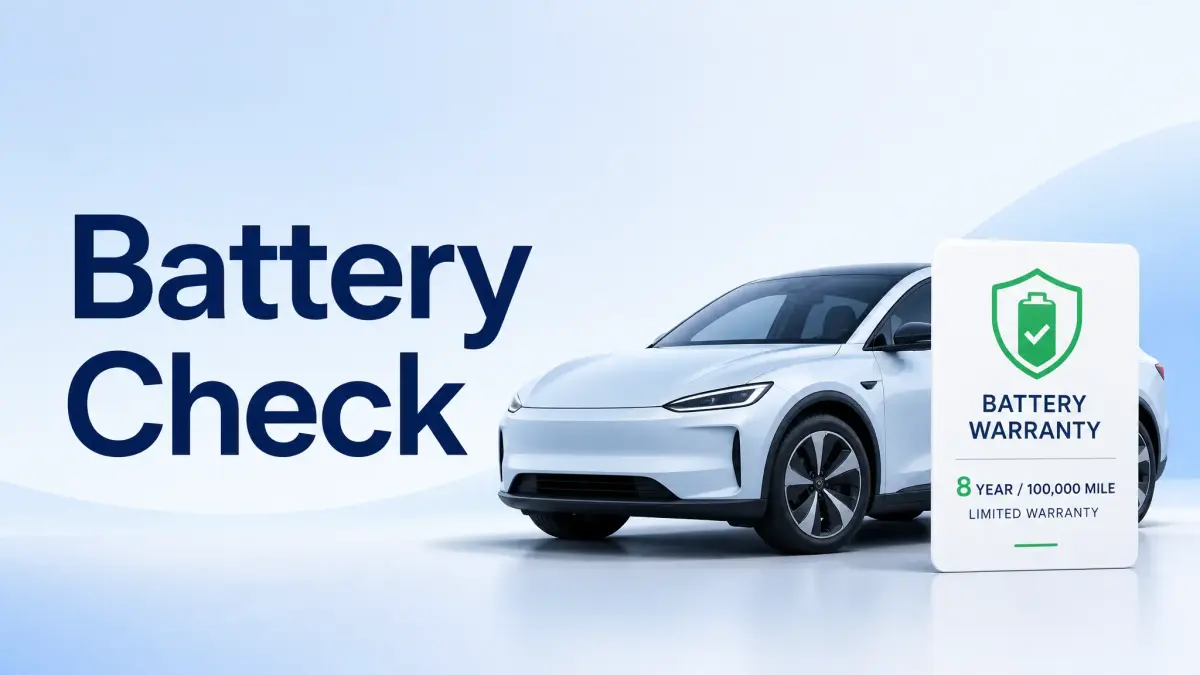
Used EV battery warranty should be one of the first things you verify before financing a secondhand electric car. A low purchase price can look attractive, but the battery, remaining warranty, charging setup, insurance, and loan term decide whether the deal is actually comfortable to own.
This guide does not tell you whether a specific used EV is a good buy. It gives you a practical checklist for reviewing the warranty, battery health, range, paperwork, and financing structure before you sign.
Buyer caution: the model year is not always the warranty clock. Ask for the original in-service date, current mileage, warranty terms, and whether coverage transfers to the next owner.
Table of Contents
- Why does battery warranty matter before financing a used EV?
- Used EV checks that affect the financing decision
- How can you verify the used EV battery warranty?
- Battery health is not the same as dashboard range
- Loan term vs remaining warranty: where risk can grow
- Incentives changed, so verify before you count them
- Normal used-car checks still matter
- Warning signs that deserve a slower decision
- Bottom line
Why does battery warranty matter before financing a used EV?
An EV battery is not just another feature. It affects range, resale value, charging behavior, and repair risk. The U.S. Department of Energy explains the basics of electric vehicles and charging in its electric vehicles and chargers guide, and buyers should treat charging access and battery condition as ownership costs, not side details.
For financing, the key question is simple: will you still be comfortable with the car if the battery warranty ends before the loan does? A six-year loan on a used EV with little battery coverage left can create a different risk profile than a shorter loan on a car with documented health and remaining protection.
Used EV checks that affect the financing decision
| Check | What to ask for | Why it matters |
|---|---|---|
| Battery warranty | Original in-service date, mileage limit, capacity threshold, transfer rules | Shows how much protection may remain during your loan. |
| Battery health | Dealer report, manufacturer app data, independent EV inspection, range history | Helps separate normal degradation from a warning sign. |
| Charging reality | Home charging option, local public charging, plug type, charging speed | Changes monthly convenience and total ownership cost. |
| Loan structure | APR, term, down payment, amount financed, total of payments | Shows whether the payment is reasonable if battery or range risk rises. |
| Insurance and repairs | Quote before signing, repair network, deductible, coverage limitations | Can affect affordability even if the car payment looks low. |
How can you verify the used EV battery warranty?
Warranty details vary by manufacturer, model, year, mileage, state, and prior ownership history. Do not rely on a listing that says “battery warranty included” without documentation. Ask the seller or dealer for the VIN, original sale or in-service date, current mileage, written warranty terms, and whether the warranty transfers to a subsequent owner.
If the warranty includes a capacity threshold, ask how capacity is measured and what documentation is required for a claim. If the car was imported, branded, modified, or previously damaged, ask whether those facts affect warranty eligibility.
- Confirm the warranty provider and exact coverage period.
- Check whether coverage is based on original sale date, in-service date, or another date.
- Ask whether battery degradation is covered only below a stated capacity threshold.
- Verify whether the warranty transfers automatically or needs registration.
- Keep screenshots, PDFs, and seller statements in your buying file.
A lower used EV price is only useful if the battery health and warranty reality fit the loan you are taking on.
Battery health is not the same as dashboard range
Estimated range on the dashboard can change with weather, driving style, tire condition, recent trips, software, and battery temperature. It is useful, but it is not a warranty promise. A battery health report, service history, and consistent test-drive observations are more helpful than one optimistic range estimate.
The Alternative Fuels Data Center explains core electric-vehicle fueling and charging concepts in its electricity basics for vehicles. Use that context to ask practical questions: where will you charge, how often, at what speed, and at what cost?
- Start the test drive with the state of charge noted.
- Compare displayed range before and after a realistic route.
- Ask for recent service records and battery diagnostic data.
- Check whether fast charging speed has changed significantly.
- Review tire condition, HVAC use, and weather before judging range.
Loan term vs remaining warranty: where risk can grow
Suppose a used EV has two years of battery warranty left and you finance it for 72 months. The payment may fit now, but years three through six would be outside that battery coverage. That does not mean the car will fail. It means your budget should include uncertainty, repairs, resale risk, and flexibility.
| Situation | Financing concern | What to consider |
|---|---|---|
| Warranty outlasts most of the loan | Lower battery coverage risk during repayment | Still verify health, insurance, charging, and total cost. |
| Warranty ends early in the loan | More years of payment after protection ends | Consider a shorter term, larger down payment, repair reserve, or different vehicle. |
| No transferable battery warranty | Higher uncertainty | Require stronger inspection, price discount, insurance clarity, and exit plan. |
Use the Loanyzer car loan calculator to compare shorter and longer terms with the same price and APR. Then read the result with the warranty timeline next to it, not separately.
Incentives changed, so verify before you count them
Do not assume a used EV incentive is available just because an older article or dealer ad mentions one. The IRS clean vehicle credit page states that clean vehicle credits are not available for vehicles acquired after September 30, 2025; buyers should review the official clean vehicle tax credits information before counting any federal benefit. State, utility, dealer, or local programs may have their own rules and deadlines.
If an incentive is part of the sales pitch, ask for the program name, eligibility source, deadline, paperwork, who receives the benefit, and whether the price still works without it.
Normal used-car checks still matter
A used EV is still a used car. Title history, recalls, tires, brakes, suspension, flood damage, accident history, liens, and seller paperwork still matter. The Federal Trade Commission used car buying guidance is a useful reminder to review paperwork and warranty terms carefully. You can also check open recalls through the National Highway Traffic Safety Administration's recall lookup tool.
For a broader buying workflow, use Loanyzer's used car financing checklist before you apply, and compare EV-specific costs with EV charging cost vs gas when the monthly budget is tight.
- Get a written battery warranty summary tied to the VIN.
- Confirm whether the warranty transfers to you.
- Request a battery health report or EV-specialist inspection.
- Get an insurance quote before signing.
- Estimate home and public charging costs.
- Check recalls, title history, liens, and seller documentation.
- Compare APR, term, amount financed, and total of payments.
- Keep a repair reserve instead of spending every dollar on down payment.
Warning signs that deserve a slower decision
Slow down if the seller cannot document warranty status, the lender has trouble valuing the vehicle, the insurer will not quote coverage, the range seems inconsistent, the title has unresolved issues, or the payment only works with a very long term. None of those automatically means walk away, but each one deserves a written answer before you sign.
Do not treat an estimated range number, a verbal warranty claim, or a low monthly payment as proof that the used EV fits your budget.
Bottom line
A used EV can be a smart purchase when the price, warranty, battery health, charging access, insurance, and loan structure all make sense together. Before you finance, verify the battery warranty in writing, compare the loan term with remaining coverage, run the payment with realistic costs, and keep enough flexibility for the risks that do not show up in the advertised price.