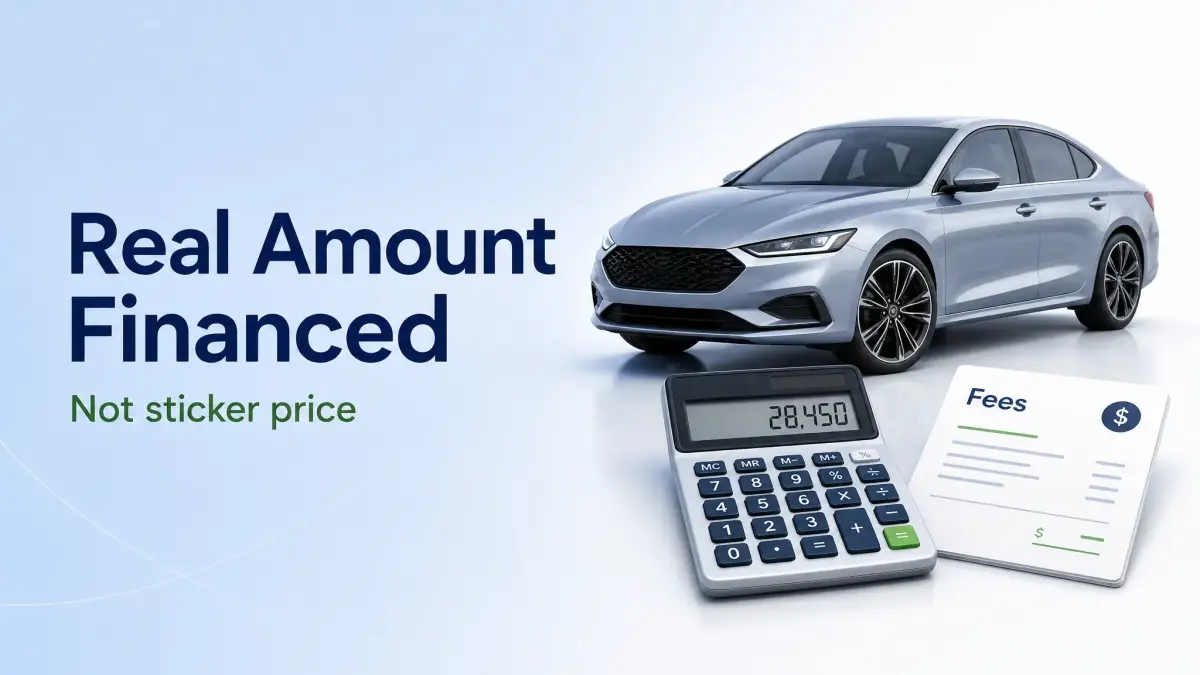
Are taxes and fees included in a car loan? Often they can be, but that does not mean you should ignore them. Sales tax, title, registration, documentation fees, and optional add-ons can increase the amount financed, which changes your monthly payment, loan-to-value ratio, and total interest cost.
The safest way to compare offers is to stop thinking only about the sticker price. Ask for the out-the-door price, subtract any down payment or trade-in credit, and then compare the actual amount financed, APR, term, finance charge, and total of payments.
Buyer caution: a monthly payment is not a price. Two deals can have the same payment while one finances more fees, add-ons, or a longer term.
Table of Contents
What costs can show up in the amount financed?
Auto financing documents separate the vehicle price from other charges, but the buyer usually experiences them as one larger transaction. Official FTC guidance on financing or leasing a car encourages shoppers to look beyond the advertised monthly payment and understand the total deal before signing.
| Cost | Common treatment | Buyer note |
|---|---|---|
| Sales tax | Often paid at purchase and sometimes financed | Rules vary by state, county, and transaction type. |
| Title and registration | Usually due as part of the transaction | Small individually, but they still affect cash due or amount financed. |
| Dealer documentation fee | May be added by the dealer | Ask whether it is mandatory and whether the amount is capped by state law. |
| GAP, service contract, protection products | Often optional and sometimes financed | Financing optional products means paying interest on them. |
| Negative equity from trade-in | May be rolled into the new loan if lender allows | This can raise LTV and create a larger payoff gap. |
Why does out-the-door price matter more than sticker price?
The sticker price tells you what the vehicle is being sold for before the full transaction is built. The out-the-door price is closer to the real purchase number because it includes taxes, required fees, and any products included in the deal. If you put only the sticker price into a calculator, you may underestimate the real payment.
The CFPB guidance on comparing auto loan offers explains that shoppers should compare more than monthly payment, including APR, total cost, and fees. That same logic applies when deciding whether to finance taxes and fees.
A simple payment example
Suppose a car is advertised at $28,000. After taxes, title, registration, a dealer doc fee, and one optional product, the out-the-door price becomes $31,200. If the buyer makes a $3,000 down payment, the estimated amount financed is $28,200, not $25,000. That extra amount may seem manageable monthly, but it can raise the total interest paid and may make the loan balance higher than the vehicle’s market value for longer.
Use Loanyzer’s car loan calculator to test the difference between sticker price and out-the-door amount financed. Then read the offer with the same discipline you would use in comparing auto loan offers.
If a fee or add-on is optional, financing it does not make it free. It usually means you are paying for it over time, with interest.
Taxes, fees, LTV, and payoff risk
Lenders often care about loan-to-value ratio, or LTV, because it compares the loan amount with the vehicle’s value. Financing taxes, fees, optional products, or negative equity can push the loan amount above the car’s value. That does not automatically mean the loan is bad, but it can make refinancing, trading in, or selling the car harder if the balance stays high.
If you need a refresher, Loanyzer’s guide to auto loan LTV ratio explains why a bigger financed amount can matter even when the monthly payment looks affordable.
Before you sign: compare the real numbers
- Ask for the out-the-door price in writing before discussing monthly payment.
- Separate vehicle price, taxes, registration, dealer fees, and optional add-ons.
- Ask whether each fee is required, negotiable, refundable, or optional.
- Compare APR with APR, not one lender’s payment against another lender’s price.
- Review amount financed, finance charge, total of payments, and loan term.
- Run the payment with and without optional products before deciding.
The CFPB auto loan shopping worksheet is useful because it pushes buyers to compare the same fields across offers instead of negotiating only around monthly payment.
Paying upfront versus financing the extras
Paying taxes or fees upfront can reduce the amount financed, but it also uses cash that might be needed for insurance, repairs, emergency savings, or registration surprises. The decision is not one-size-fits-all. A larger down payment may lower interest cost and LTV; keeping more cash may protect your household from becoming car-poor after purchase.
For affordability, connect the final amount financed to your budget, not just the lender’s maximum approval. Loanyzer’s how much car can I afford guide can help you test the monthly payment against insurance, fuel, maintenance, and other real ownership costs.
The calm way to compare two car deals
Line up each offer with the same vehicle price, out-the-door price, amount financed, APR, term, monthly payment, finance charge, and total of payments. If one offer has a lower payment, check whether it uses a longer term, a larger financed amount, or optional products rolled into the loan. A good deal should make sense on paper before it feels comfortable at the finance desk.
Taxes and fees can be included in a car loan, but the better question is whether the full financed amount still fits your budget and exit plan. Compare the real amount financed first; the monthly payment should come second.