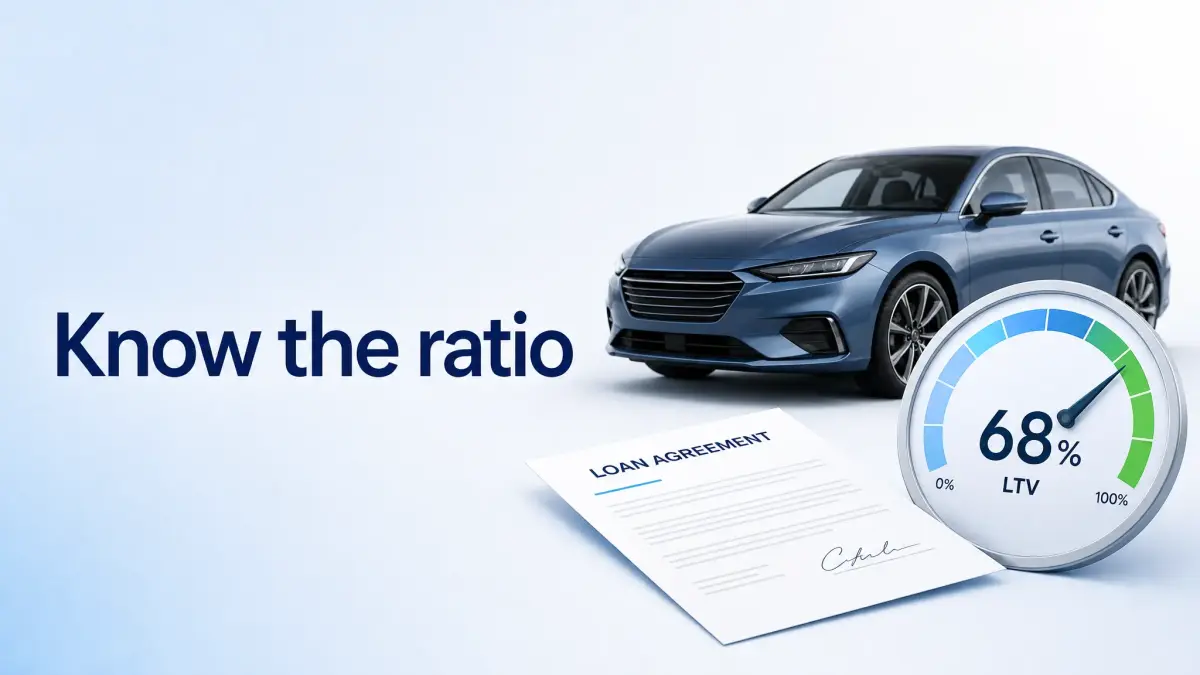
Auto loan LTV ratio is a quiet number that can change how a lender views your car deal. It compares the amount you want to borrow with the vehicle's value, and it can be affected by your down payment, trade-in equity, negative equity, taxes, fees, and add-ons rolled into the loan.
This is not a magic approval formula. Lenders use their own policies, and credit, income, debt, vehicle age, mileage, and documentation still matter. But understanding LTV helps you spot when a deal is becoming more fragile before you sign.
Buyer caution: a comfortable monthly payment can still hide a high-LTV loan if the term is long, the down payment is small, or extras are financed into the balance.
Table of Contents
- What does auto loan LTV ratio mean?
- What changes your LTV before you sign?
- A simple LTV example
- Why can high LTV affect approval risk?
- How do down payment and trade-in equity change the picture?
- How can add-ons quietly raise LTV?
- LTV vs monthly payment vs total cost
- Questions to ask before signing a high-LTV auto loan
- Bottom line
What does auto loan LTV ratio mean?
Loan-to-value compares the loan amount with the collateral value. A federal consumer-finance explainer describes loan-to-value in an auto-loan context as the amount borrowed compared with the vehicle value, and its auto loan LTV explanation is a good starting point for the concept.
A simple version looks like this: if the car is valued at $25,000 and the loan amount is $22,500, the LTV is 90%. If the loan amount is $27,500 because taxes, fees, add-ons, or negative equity were rolled in, the LTV is 110%. The higher number does not automatically mean denial, but it can increase lender risk and borrower risk.
What changes your LTV before you sign?
Many buyers think LTV is only about the sticker price. In practice, the loan balance can move for several reasons.
- Down payment: more cash down usually lowers the amount financed and may lower LTV.
- Trade-in equity: positive equity can reduce the new loan amount; negative equity can increase it.
- Taxes and registration: if financed, these costs raise the balance even though they do not make the car worth more.
- Dealer add-ons: GAP, service contracts, protection packages, and other products can raise the amount financed.
- Vehicle valuation: lenders may use their own value source, not the seller's asking price.
- Vehicle age and mileage: older or higher-mileage vehicles may face tighter lender limits.
If you need to estimate the payment impact, use the Loanyzer car loan calculator with the same APR and term, then change only the amount financed.
A simple LTV example
| Scenario | Vehicle value used by lender | Amount financed | Approximate LTV | What changed |
|---|---|---|---|---|
| Clean structure | $25,000 | $22,500 | 90% | Buyer made a down payment and did not roll in extras. |
| Taxes and fees financed | $25,000 | $25,800 | 103% | Non-vehicle costs were added to the loan. |
| Add-ons financed | $25,000 | $27,200 | 109% | Products increased the balance without increasing lender collateral value. |
| Negative equity rolled in | $25,000 | $30,000 | 120% | Old loan balance moved into the new deal. |
These numbers are educational examples, not lender limits. The important lesson is direction: when the amount financed rises faster than the vehicle value, LTV rises.
Why can high LTV affect approval risk?
A lender cares about LTV because the car is collateral. If the loan balance is much higher than the vehicle value, the lender has less protection if the borrower defaults and the vehicle is repossessed. The borrower also has less flexibility because selling or trading the car may not pay off the loan.
The official auto loans key terms page is useful when reading a contract because it separates concepts like amount financed, finance charge, APR, and total of payments. Federal trade guidance also urges consumers to understand the full financing or leasing terms before agreeing to a vehicle deal in its financing or leasing a car guidance.
Key takeaway: LTV is not the same as affordability. A loan can be approved and still leave you with too little flexibility if the balance starts above the car's value.
How do down payment and trade-in equity change the picture?
A down payment can lower LTV because it reduces the amount financed. Positive trade-in equity can do the same. Negative equity does the opposite: it can push the new loan above the value of the new car before the first payment is made.
If your trade-in has an existing loan, review Loanyzer's auto loan payoff quote guide before relying on a dashboard balance. For a deeper look at rollover risk, use the negative equity on a car loan guide.
How can add-ons quietly raise LTV?
Add-ons may be useful in some situations, but financing them means borrowing more. A $1,500 service contract, $900 protection package, or other product may look small when spread across a long term, but it still raises the amount financed and can raise LTV.
That does not mean every add-on is bad. It means the right question is not only "How much does this add to the payment?" Ask for the cash price, the financed cost, whether it is optional, cancellation terms, and where it appears in the contract. Loanyzer's auto loan add-ons guide walks through that finance-office decision.
- Ask for the vehicle selling price, amount financed, and estimated lender value separately.
- Calculate LTV with and without taxes, fees, add-ons, and negative equity.
- Compare the same amount financed across offers before choosing a lender.
- Check whether a larger down payment would materially lower risk.
- Keep emergency savings in mind; do not drain cash only to chase a cleaner ratio.
LTV vs monthly payment vs total cost
A long loan term can make a high-LTV deal feel affordable month to month. The risk is that the balance may stay high for longer, especially if the car depreciates faster than the loan amortizes. That can matter if you need to sell, trade, refinance, or respond to an insurance total loss.
Review how much car can I afford for the budget side, and how to compare auto loan offers for the APR, term, fees, and total-cost side. LTV is one risk lens, not the whole decision.
Questions to ask before signing a high-LTV auto loan
- What vehicle value is the lender using?
- What is the exact amount financed?
- Which taxes, fees, and products are being rolled into the loan?
- Is any negative equity from my trade-in included?
- Would a larger down payment or fewer add-ons change the lender's terms?
- How long might I be upside down if the car depreciates quickly?
- Can I afford insurance, maintenance, registration, and repairs on top of the payment?
When a lender or dealer focuses only on the monthly payment, bring the conversation back to amount financed, APR, term, total of payments, and LTV.
Bottom line
Auto loan LTV ratio helps you see whether the loan balance is reasonable compared with the vehicle value. Use it alongside payment, APR, term, total cost, insurance, and emergency cash. A lower LTV is not a guarantee of approval or a perfect deal, but a very high LTV is a signal to slow down and review the structure before signing.