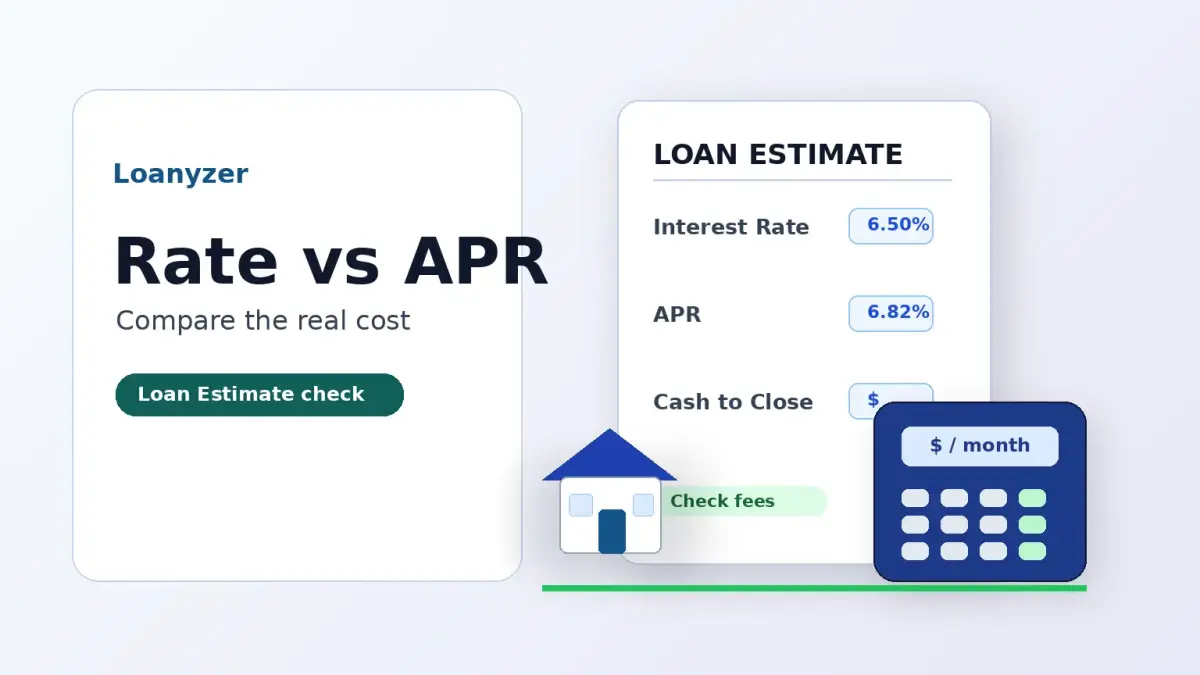
Mortgage APR vs interest rate is one of the easiest places to compare the wrong number when you are shopping for a home loan. The interest rate helps estimate your monthly principal and interest payment. APR tries to show a broader yearly cost by including the rate plus certain loan charges, which is why two offers with the same rate can still have different APRs.
The practical goal is not to chase the lowest number in isolation. It is to compare the rate, APR, points, lender fees, cash to close, monthly payment, and how long you expect to keep the loan before you decide which offer is actually stronger.
Key takeaway: the interest rate helps explain the monthly payment. APR helps compare cost across offers. Neither number is enough unless you also review the Loan Estimate line by line.
Table of Contents
- Interest rate and APR are related, but not identical
- Where can you find both numbers on the Loan Estimate?
- Why can a lower rate have a higher upfront cost?
- A simple two-offer comparison
- APR can be useful and still imperfect
- How can you compare Loan Estimates without overthinking it?
- Cases where the interest rate matters more
- Cases where APR deserves extra weight
- Bottom line
Interest rate and APR are related, but not identical
Your mortgage interest rate is the price charged on the loan balance. It is the number most buyers notice first because it drives the principal and interest part of the monthly payment. A federal consumer finance explainer covers this distinction in consumer explainer on mortgage interest rate versus APR.
APR, or annual percentage rate, is meant to reflect a broader annualized cost of credit. It may include the interest rate plus certain charges such as points, mortgage broker fees, and some lender fees. That is why APR is often higher than the interest rate on a fixed-rate mortgage with upfront costs.
Where can you find both numbers on the Loan Estimate?
The Loan Estimate is the document lenders provide after you apply for a mortgage and give the required information. The federal Loan Estimate explainer shows where monthly payment, closing costs, cash to close, and comparison figures appear.
For a quick review, start with page 1 for the loan terms, projected payments, and estimated cash to close. Then review page 2 for origination charges, points, lender credits, third-party services, prepaids, and escrow. Finally, page 3 gives comparison information, including APR, that can help you compare offers more consistently.
| Number | What it helps answer | What it can miss |
|---|---|---|
| Interest rate | What principal and interest payment does this loan create? | Upfront points, lender fees, credits, closing costs, and how long you keep the loan. |
| APR | Which offer has the lower annualized cost when certain fees are included? | Cash-flow pressure, seller credits, future refinance plans, and some costs that may not be included. |
| Cash to close | How much money do I need to complete the transaction? | Whether a lower rate is worth using more savings upfront. |
Why can a lower rate have a higher upfront cost?
A lower advertised interest rate may require discount points or higher lender charges. Points are prepaid interest: you pay more upfront in exchange for a lower rate. That can be reasonable if the monthly savings are meaningful and you keep the loan long enough to pass the break-even point. It can be a poor fit if it drains savings you need for moving, repairs, escrow changes, or emergency reserves.
Loanyzer's guide to mortgage discount points and lender credits is the natural next step when the APR difference is caused by upfront pricing. You can also use the mortgage affordability calculator to test how the payment changes under different rate and cash-to-close scenarios.
- Calculate the monthly payment difference.
- Divide upfront points by monthly savings to estimate break-even.
- Ask how long you realistically expect to keep the mortgage.
- Check whether the upfront cash would weaken reserves after closing.
- Compare the same lock period, loan type, down payment, and mortgage insurance assumptions.
A simple two-offer comparison
Suppose Lender A offers a lower interest rate but charges points. Lender B offers a slightly higher rate with lower upfront cost. The lowest rate may look better on the payment line, but the better offer depends on how much cash you give up and whether the lower payment has enough time to repay that upfront cost.
| Comparison item | Offer A | Offer B | Question to ask |
|---|---|---|---|
| Interest rate | Lower | Higher | How much does the monthly payment change? |
| APR | May be close or higher because of points | May be close or lower if fees are lower | Which offer has the lower broader cost if kept long enough? |
| Cash to close | Higher | Lower | Will the lower-rate offer leave enough money after closing? |
| Best fit | Longer ownership or no near-term refinance expected | Shorter expected holding period or tighter cash position | What is realistic for this buyer, not just mathematically clean? |
This is why comparing only APR can still be incomplete. If you expect to sell, refinance, or pay off the loan early, a higher-upfront-cost offer may not have enough time to pay for itself. If you expect to keep the mortgage for many years, a lower rate may be worth more, but only after you compare the full Loan Estimate.
APR can be useful and still imperfect
APR is useful because it makes lenders show more than the note rate. Still, it is not a perfect personal decision tool. It relies on assumptions, and it may be less intuitive when offers include adjustable rates, temporary buydowns, mortgage insurance, lender credits, seller credits, different lock periods, or different loan terms.
The federal guide to reviewing Loan Estimates encourages borrowers to compare offers side by side. That side-by-side review matters because APR alone does not tell you whether one lender assumed different taxes, insurance, prepaid interest, or escrow deposits.
Buyer caution: APR is a comparison tool, not a promise that one mortgage is automatically best for your situation. Confirm what fees are included, whether assumptions match, and how long you plan to keep the loan.
How can you compare Loan Estimates without overthinking it?
Start by making the offers comparable. Ask each lender for the same loan type, purchase price, down payment, credit profile assumptions, lock period, occupancy type, and closing date. If one quote assumes a shorter lock, different points, or different mortgage insurance, the APR comparison may be noisy.
- Match the loan scenario. Same property price, down payment, loan type, term, occupancy, and lock period.
- Compare the monthly payment. Review principal, interest, taxes, insurance, mortgage insurance, and HOA dues where applicable.
- Review Section A lender charges. Points and origination charges can explain why APR differs.
- Separate cash to close from total cost. A low APR may still require more money upfront.
- Estimate break-even. For points, compare upfront cost against monthly savings.
- Check flexibility. Consider reserves, moving costs, repair risk, and whether you may refinance later.
Cases where the interest rate matters more
The interest rate may deserve extra attention when the monthly payment is the binding constraint. For example, if the difference between two offers changes whether the payment fits your budget, the rate and payment deserve careful review. Loanyzer's home affordability guide can help you frame the payment against income, debts, cash reserves, and other ownership costs.
Still, do not separate the rate from the cost of getting that rate. A very attractive rate with expensive points may be weaker than a slightly higher rate if you need the cash cushion more than the payment reduction.
Cases where APR deserves extra weight
APR deserves extra attention when you are comparing similar fixed-rate offers with the same term and similar assumptions. In that setting, APR can expose a lender whose low note rate is paired with higher required charges. It is especially helpful when two lenders quote the same interest rate but one offer has noticeably higher APR.
Use APR as a filter, then go back to the details. If the APR difference is meaningful, ask which charges caused it. If the APR difference is tiny, the better decision may come down to cash to close, servicing expectations, lender responsiveness, lock terms, and your comfort with the payment.
- Same loan amount, term, and product?
- Same lock period and closing date?
- Any discount points or lender credits?
- Same estimate for taxes, insurance, HOA, and mortgage insurance?
- Does lower APR require more cash than you want to spend?
- Does lower rate pay back its upfront cost before you expect to sell or refinance?
Bottom line
Mortgage APR vs interest rate is not a contest where one number always wins. The interest rate helps you understand the payment. APR helps you compare the cost of credit. Cash to close shows the pressure on your savings. A careful buyer reviews all three, then checks points, credits, break-even timing, reserves, and the full Loan Estimate before choosing a lender.