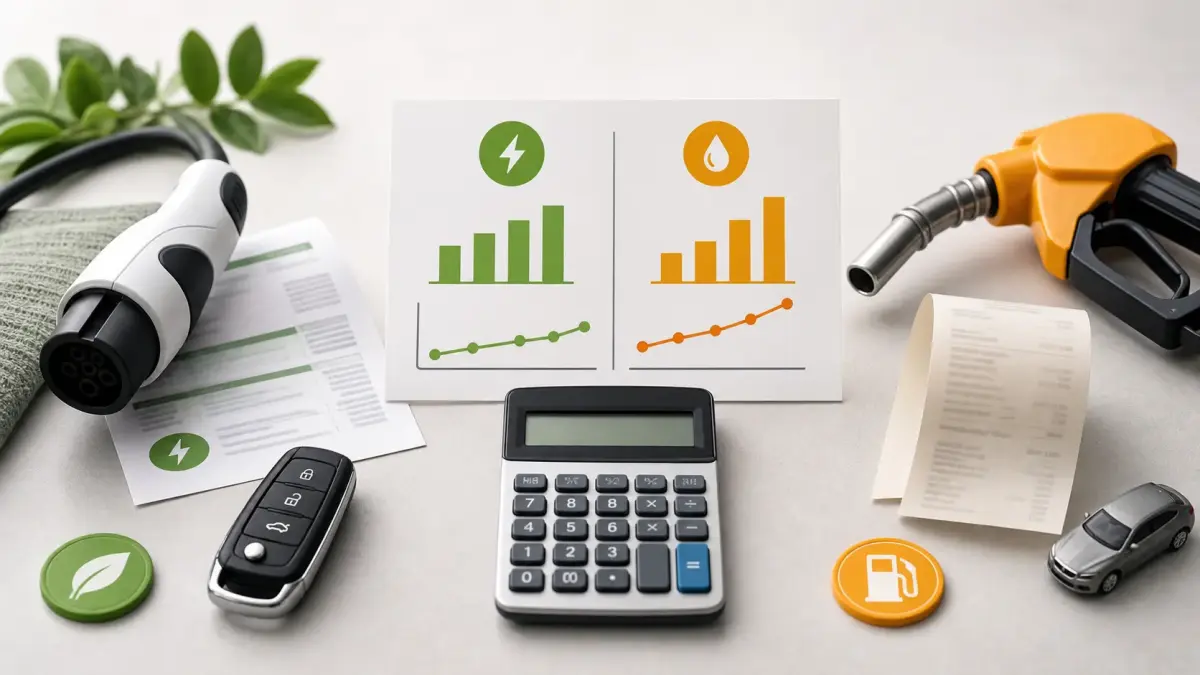
Reviewed May 2026. Comparing EV charging cost vs gas is not just a fuel-price question. A gasoline car is usually measured in miles per gallon, while an electric vehicle is measured in kilowatt-hours, miles per kWh, or kWh per 100 miles. Once you translate both vehicles into cost per mile, the comparison becomes much clearer.
This guide focuses on real driving costs: home charging, public charging, road trips, charging losses, utility rates, gas MPG, and the ownership costs that still matter after fuel. If you are also comparing the purchase or lease itself, pair this math with Loanyzer’s electric vehicle financing guide and the broader car finance resources.
Table of Contents
- The quick formula
- How does a kWh affect EV cost math?
- Home charging vs public charging
- Charging losses: why the wall cost can be higher than the battery number
- Example: same driver, three charging patterns
- Road trips change the math
- Why should you not isolate fuel from the rest of ownership?
- Checklist: compare EV charging cost vs gas before you buy
- Sources checked
- Bottom line
The quick formula
To compare EV charging and gasoline fairly, convert each option into cost per mile.
| Vehicle type | Formula | Simple example |
|---|---|---|
| Gas vehicle | Gas price per gallon ÷ MPG | $3.60 ÷ 30 MPG = $0.12 per mile |
| EV, using miles per kWh | Electricity price per kWh ÷ miles per kWh | $0.16 ÷ 3.5 miles/kWh = about $0.046 per mile |
| EV, using kWh per 100 miles | (kWh per 100 miles × electricity price) ÷ 100 | 30 kWh × $0.16 ÷ 100 = $0.048 per mile |
Then multiply cost per mile by your expected monthly or annual mileage. For 12,000 miles per year, a $0.12-per-mile gasoline cost is about $1,440 per year. A $0.048-per-mile EV energy cost is about $576 per year before adjusting for charging losses or more expensive public charging.
How does a kWh affect EV cost math?
A kilowatt-hour, or kWh, is a unit of electrical energy. If your utility charges $0.16 per kWh and your EV uses 30 kWh to travel 100 miles, the electricity for those 100 miles costs about $4.80 before any taxes, fees, demand charges, idle fees, or charging losses.
FuelEconomy.gov explains that EV labels use metrics such as MPGe and kWh per 100 miles. MPGe is useful for comparing vehicle efficiency across fuel types, but kWh per 100 miles is often more practical for your wallet because it connects directly to the electricity bill. You can read EPA and DOE label guidance at FuelEconomy.gov.
Home charging vs public charging
Home charging is usually the easiest scenario to estimate because you can use your local utility rate, including any time-of-use plan. Public charging is less predictable. Level 2 public charging may be billed by kWh, session, time, or parking rules. DC fast charging is convenient for road trips, but it can cost much more than residential electricity and may include idle fees or membership pricing.
| Charging situation | What to check | Why it changes the comparison |
|---|---|---|
| Home overnight charging | Your effective utility rate, time-of-use pricing, taxes, and charger installation cost | Often the strongest EV fuel-cost case, especially if most miles are charged at home |
| Apartment or workplace charging | Access rules, payment method, uptime, parking limits, and backup options | Low-cost charging may be valuable, but unreliable access can push you toward public networks |
| Public Level 2 charging | Price per kWh or per hour, parking fees, and session limits | Useful for topping up, but not always cheaper than gas on a per-mile basis |
| DC fast charging | Network price, membership plans, peak pricing, and idle fees | Best for road trips and urgent charging, but frequent use can narrow or erase EV fuel savings |
Charging losses: why the wall cost can be higher than the battery number
EV efficiency ratings describe vehicle energy use, but the electricity drawn from the wall can be higher than the energy stored in the battery because charging is not perfectly efficient. FuelEconomy.gov notes that battery charging efficiency can vary and is often in the 84% to 93% range based on published studies. In plain English, a car that needs 30 kWh in the battery may draw more from the outlet.
A practical estimate is to divide the vehicle’s kWh by expected charging efficiency. For example, if the car uses 30 kWh per 100 miles and your charging efficiency is 90%, wall energy is about 33.3 kWh per 100 miles. At $0.16 per kWh, that is about $5.33 per 100 miles instead of $4.80.
Example: same driver, three charging patterns
Assume 12,000 miles per year, an EV that uses 30 kWh per 100 miles before charging losses, 90% charging efficiency at home, gasoline at $3.60 per gallon, and a gas vehicle rated at 30 MPG. These are educational estimates, not offers or predictions.
| Scenario | Assumption | Estimated annual energy or fuel cost |
|---|---|---|
| Gas vehicle | 12,000 miles ÷ 30 MPG × $3.60/gallon | About $1,440 |
| EV mostly home charging | 30 kWh/100 miles ÷ 90% efficiency × $0.16/kWh | About $640 |
| EV mixed charging | 70% home at $0.16/kWh and 30% public at $0.42/kWh, adjusted simply | About $952 |
| EV mostly fast charging | 30 kWh/100 miles at $0.42/kWh before network fees | About $1,512 |
Buyer caution: do not use the best-case home charging estimate as your only number if you live in an apartment, travel often, or expect to rely on DC fast charging. Run at least one conservative scenario before deciding.
The takeaway is not that every EV is cheaper every time. The takeaway is that your charging mix matters. A driver with low-cost home charging may see a large fuel-cost advantage. A driver who relies mostly on fast charging may be much closer to gasoline cost, or occasionally higher depending on prices and vehicle efficiency.
Road trips change the math
Road trips often involve highway speeds, weather effects, cargo weight, charging stops, and DC fast charging prices. That can reduce efficiency and raise cost per mile. Before choosing an EV primarily for savings, map a few real trips and check charging networks on the route. The DOE Alternative Fuels Data Center offers tools such as the Vehicle Cost Calculator and information about charging access that can help with model comparisons.
Why should you not isolate fuel from the rest of ownership?
Fuel savings can be meaningful, but an EV decision still depends on the full ownership picture. Compare insurance quotes before buying, because premiums can vary by model, repair cost, driver profile, garaging ZIP code, and coverage choices. Also consider tires, registration fees, charger installation, battery warranty, depreciation, loan APR, lease mileage limits, and resale risk.
DOE’s Alternative Fuels Data Center notes that EV energy costs are generally lower than comparable conventional vehicles, while purchase prices can be higher and infrastructure access varies. It also explains that EVs use different fuel-economy metrics such as MPGe and kWh per 100 miles. See the AFDC discussion of electric vehicle benefits and considerations.
Checklist: compare EV charging cost vs gas before you buy
- Find the EV’s kWh per 100 miles or miles per kWh from the window sticker, owner data, or FuelEconomy.gov.
- Find your real residential electricity rate, including time-of-use pricing, taxes, and delivery charges when applicable.
- Estimate charging losses instead of assuming every paid kWh reaches the battery.
- List where you will charge most miles: home, work, apartment, public Level 2, or DC fast charging.
- Use gasoline price and the realistic MPG of the vehicle you would buy, not an idealized number.
- Run annual cost at your real mileage: commuting, errands, weekend driving, and road trips.
- Get insurance quotes for both vehicles before signing.
- Include charger installation or apartment charging costs if they apply.
- Compare loan or lease terms separately from energy savings so a lower fuel bill does not hide a weaker financing deal.
Sources checked
This article uses official resources from FuelEconomy.gov, the EPA, and the DOE Alternative Fuels Data Center. FuelEconomy.gov explains EV label metrics and charging-efficiency context at fueleconomy.gov and EV technology basics at fueleconomy.gov. EPA’s green vehicle information discusses EV efficiency and emissions context at epa.gov. DOE AFDC provides EV cost and calculator resources at afdc.energy.gov.
Bottom line
The cleanest comparison is cost per mile. Divide gas price by MPG, then compare it with electricity price divided by miles per kWh or kWh per 100 miles. After that, adjust for charging losses, public charging, road trips, insurance, maintenance, and financing. EV charging can be much cheaper than gas for drivers with reliable home charging, but the real answer depends on your route, your utility rate, your charging mix, and the vehicle you actually buy.