A voluntary repossession car loan decision usually starts with pressure: the payment is late, the lender is calling, and returning the car sounds like a clean way out. It is not that simple. A voluntary surrender may change how the vehicle is collected, but it generally does not erase the loan, the credit impact, or the possible deficiency balance after the lender sells the car.
This guide explains what usually happens before and after a voluntary surrender, how deficiency balance math works, what to ask your lender in writing, and which alternatives may be worth checking before you hand over the keys. It is general education for US borrowers, not legal advice for a specific state or contract.
Returning a financed car does not automatically cancel the loan balance. The payoff amount, sale price, fees, and your contract still matter.
Table of Contents
Voluntary repossession basics
Voluntary repossession, often called voluntary surrender, means you arrange to give the financed vehicle back to the lender or servicer instead of waiting for an involuntary repossession. The lender can still report the account as delinquent or repossessed, sell the vehicle, apply the sale proceeds to the loan, and pursue any remaining balance allowed by the contract and state law.
The Federal Trade Commission vehicle repossession guide explains that a lender may be able to repossess a vehicle without going to court if the borrower defaults, but rules about notices, sale, property, and deficiency can depend on state law and the loan documents. The CFPB repossession explainer also notes that the lender may sell the vehicle and that the borrower may still owe money if the sale does not cover the balance and permitted costs.
Voluntary repossession vs. other options
A voluntary surrender can sometimes reduce towing or confrontation risk because you coordinate the return. But it may also reduce your control over timing, sale price, and documentation if you move too quickly. Before deciding, compare the realistic choices side by side.
| Option | What it may solve | Main risk to check |
|---|---|---|
| Call the lender before default gets worse | May open hardship, extension, repayment, or due-date options. | Any agreement should be in writing and should explain fees, credit reporting, and whether interest continues. |
| Sell the car yourself | May produce a higher sale price than auction if you can sell legally and safely. | You need a clear payoff plan, title/lien handling, and enough sale proceeds or cash to cover the gap. |
| Refinance | May lower payment if credit, income, vehicle value, and lender terms support it. | Approval is not guaranteed, and negative equity can make refinancing difficult or expensive. |
| Voluntary surrender | May make the return more orderly than an involuntary repossession. | Credit damage and deficiency balance can still remain after sale. |
| Wait for involuntary repossession | May require no coordination from you. | More fees, stress, personal-property problems, and less control over timing may result. |
If you are trying to understand whether the car is worth less than the loan, review Loanyzer's negative equity on a car loan guide. If you need the exact amount required to satisfy the loan, start with a written payoff quote, not only the balance shown online.
Deficiency balance math
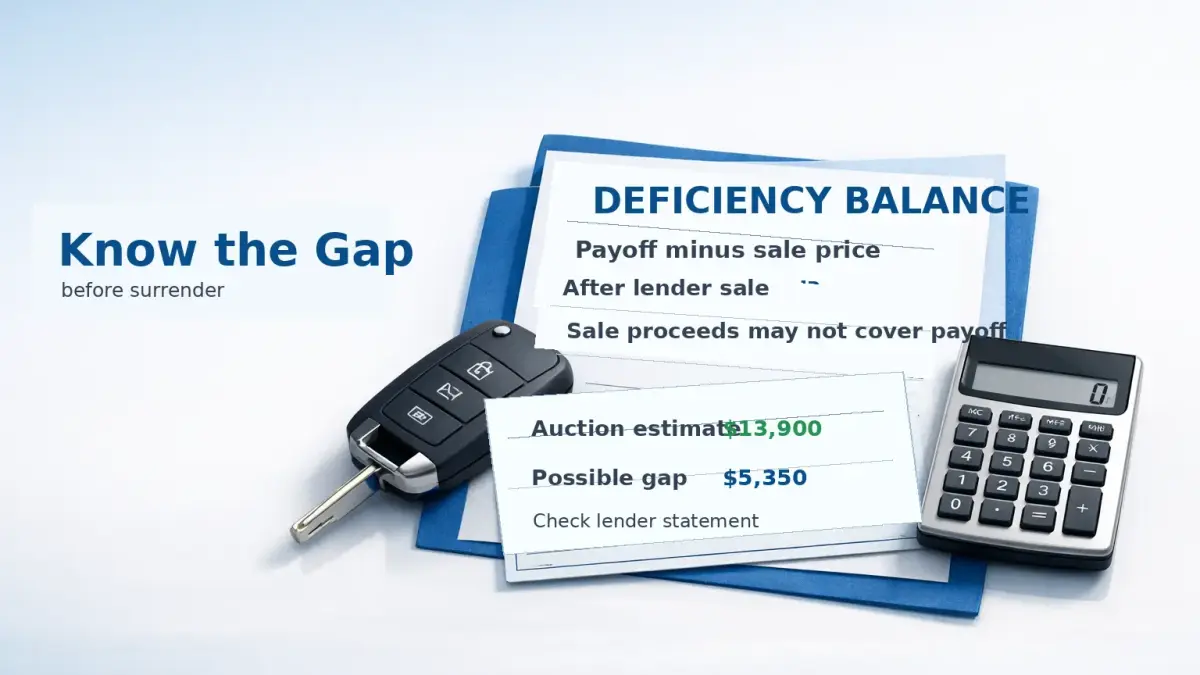
A deficiency balance is the remaining amount after the lender sells the vehicle and applies the net sale proceeds to the loan, subject to the contract and applicable law. The gap can grow if the payoff is high, the vehicle sells for less than expected, or allowed repossession, storage, sale, late, and collection costs are added.
| Example item | Hypothetical amount | What it means |
|---|---|---|
| Loan payoff before sale | $18,400 | The amount needed to satisfy the loan before repossession-related costs. |
| Auction sale price | $13,900 | The gross amount the lender receives from selling the vehicle. |
| Permitted repossession/sale costs | $850 | Costs that may be added depending on contract and law. |
| Potential deficiency | $5,350 | The unpaid gap before considering disputes, state limits, or settlements. |
A voluntary surrender may avoid some logistics, but it can still leave a deficiency balance if the vehicle sale does not cover the loan and permitted costs.
This is why the sale path matters. If you can safely sell the car yourself before default deepens, the higher retail/private-party value may reduce the gap. That is not always possible, especially when the vehicle has a lien, negative equity, damage, or no buyer, but it is worth checking before assuming surrender is the only choice.
Questions to ask before surrendering the car
Call the lender or servicer before handing over the vehicle and keep records of the conversation. If the lender offers an option, ask for the terms in writing before relying on it.
- Ask for the current payoff amount and whether interest or fees will continue.
- Ask whether hardship assistance, extension, repayment plan, due-date change, or refinance is available.
- Ask how voluntary surrender will be reported to credit bureaus.
- Ask where and how to return the vehicle, and request a written receipt.
- Ask how the vehicle will be sold and when you will receive sale or deficiency notices.
- Ask whether personal property should be removed before surrender.
- Ask how to dispute fees, sale price, or deficiency if something looks wrong.
If refinancing is still realistic, compare the total cost with Loanyzer's auto loan refinance calculator. If the problem is the full payment structure, the car loan calculator can help you test how APR, remaining balance, and term affect payment, without treating the estimate as an approval or lender offer.
Credit impact and collection risk
Voluntary repossession can still appear as a serious negative event because the account was not paid as agreed. Late payments before surrender, the repossession notation, charge-off activity, collection activity, and any unpaid deficiency can all matter. The precise credit impact depends on your broader credit file and how the account is reported.
Do not rely on a promise that voluntary surrender will “save” your credit unless the lender gives specific written terms and you understand what will be reported. A auto repossession bulletin is written for supervised companies, but it is useful consumer context because it highlights wrongful repossession, payment processing, personal property, and communication problems that can create real harm.
Documentation if surrender becomes unavoidable
If you decide to surrender the car after checking alternatives, treat the process like a paper trail, not a casual drop-off. Documentation can matter later if there is a dispute over condition, personal property, sale notices, fees, or the deficiency statement.
- Remove personal property: check the cabin, trunk, glove box, garage opener, toll transponder, plates if your state requires it, and digital garage or vehicle apps.
- Photograph the vehicle: capture mileage, VIN, exterior, interior, keys, accessories, and condition on the day of return.
- Get written surrender instructions: confirm date, location, contact person, whether towing is involved, and what happens next.
- Request a receipt: keep proof that the vehicle was returned and who accepted it.
- Watch for sale and deficiency notices: review dates, sale price, fees, and dispute instructions.
Outside help for disputes
Consider outside help if you believe the vehicle was taken despite an agreement, personal property was not returned, notices are missing, fees look inflated, the sale price seems unreasonable, or a collector is pursuing a balance you dispute. A local legal aid organization, consumer attorney, state attorney general office, or financial counselor may be able to explain options that depend on your state and facts.
You can also use the federal consumer complaint portal for certain financial product complaints. Keep copies of your contract, payment history, payoff quote, surrender receipt, notices, sale statement, and all lender messages before filing a complaint or disputing a balance.
Bottom line
A voluntary repossession car loan decision should be made only after you understand the payoff, vehicle value, possible sale price, fees, credit reporting, and deficiency balance risk. Returning the car may feel like closure, but the financial file can remain open. Ask for written options first, compare the math, document every step, and get local help when state-law rights or collection disputes are involved.